Core training might be the noisiest discussion in all of gymnastics. What exercises? How many reps and sets? Is this one dangerous? Will that one actually help skills?
After a decade of digging through the research and testing it in the gym, here’s the good news: it gets simple once you stop collecting random drills and start training the core for what it actually does. Here are the five things I want every coach to understand.
Table of Contents
1. A strong core creates, disperses, and transfers force — in every direction
Forget “abs.” A strong core is the ability to create, disperse, and transfer high forces, 360 degrees around the trunk. Picture a soup can: it protects the essential stuff inside, it produces and buffers force, and it acts as a stable base for the arms and legs.
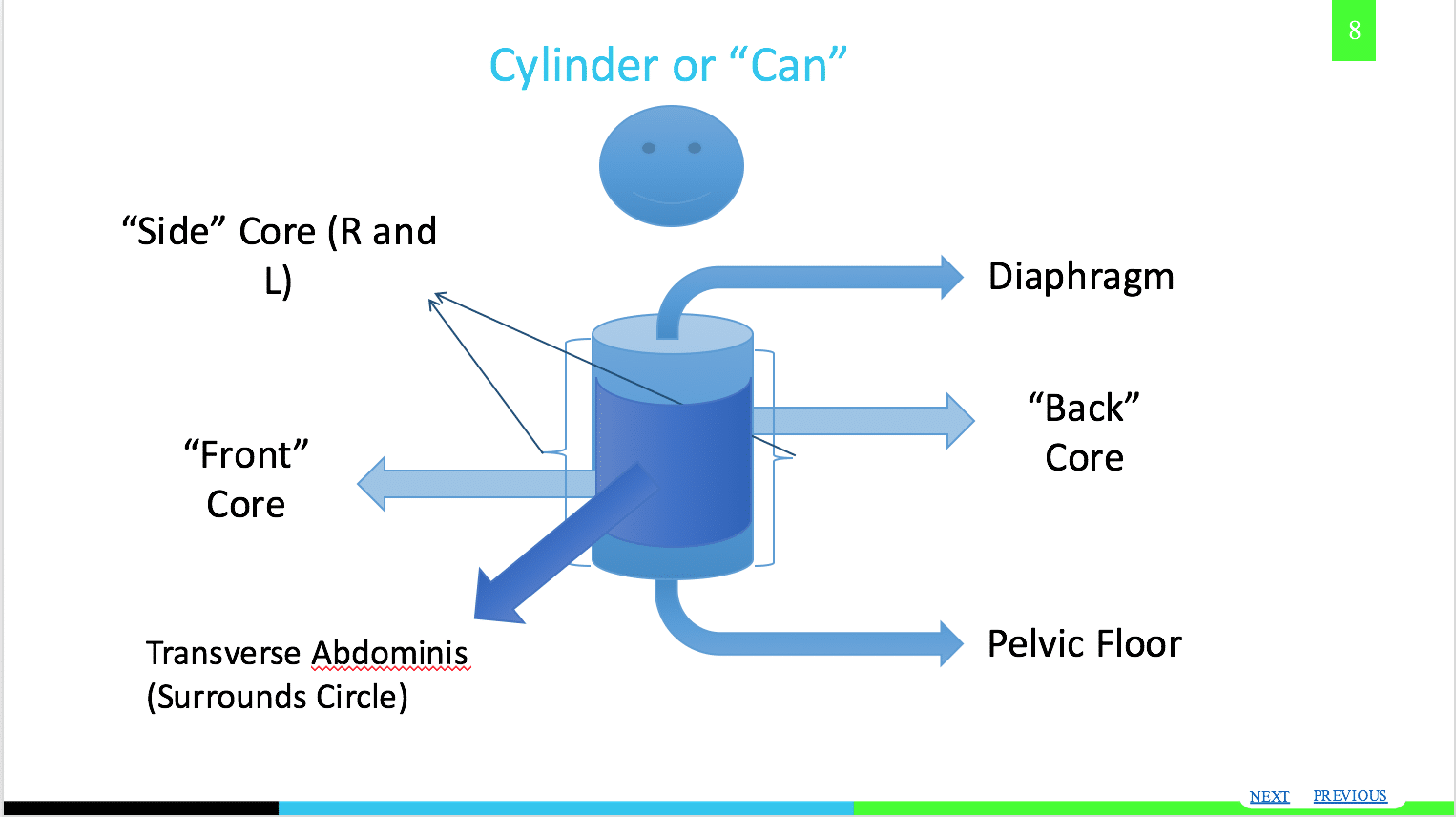
You can see all three jobs in real skills.
Create is the arch-hollow snap of a back handspring, force generation for shape creation.
Disperse is holding a tight hollow set with the ears covered on the floor, dispersing force and not buckling against the springs so you can maintain that shape.
Transfer is absorbing a double-back landing through the legs without the middle collapsing. Train the can to work in all directions, not just to crunch forward.
2. Use the hybrid model — old school and new school
The old debate was body-weight-and-gymnastics-specific versus weights-and-general-cross-training. The answer isn’t one or the other. The hybrid model mixes body-weight gymnastics-specific work with the right types of weighted drills.

Purely old-school (leg lifts, hollow rocks, etc) misses the loading that builds robust tissue; purely new-school (suitcase carries, bear crawls, et.) drifts away from the shapes gymnastics actually demands.
When you blend them — a leg lift and an arch-up next to a suitcase carry and a press-out — you get a core that’s both sport-specific and genuinely strong. The literature on youth artistic gymnastics S&C (Moeskops et al., 2018) supports exactly this kind of blended approach.
3. Train core control and core strength — they’re not the same
Two different qualities, and gymnasts need both. Core strength is building the capacity to create and resist movement. You need more core strength as levels increase and skill difficulty increases, because there is, on average, more force per skill. The core strength required to maintain a deep pike position in a jam is more than that of a kip.

Core control is position, bracing, and breathing — coordinating a 360-degree brace with breathing while moving. You need more awareness and core control to maintain position in a double double than you do a back handspring.
Most gyms drill strength and completely skip control. Start warm-ups with position and bracing work: cat-camel to feel neutral versus hollow and arch, then a real 360 brace with breathing, then dead bugs and bird dogs to coordinate it with limb movement. This is the “inner layer” — the small stabilizers that fire automatically — and it’s what makes the strong outer layer actually usable.
4. Program for every demand — including the “anti” movements
Gymnastics loads the core in specific ways, so train each one on purpose: flexion (kip → leg lift), extension (back handspring → arch-up), rotation (full/blind change → around-the-world), traction (giants → resisted pull-up), and compression (rebounding/landings → depth jump).
Then train the mirror image — resisting movement, the “anti” work: anti-extension, anti-flexion, anti-side-bend, anti-rotation, and anti-buckling planks and carries. This is straight out of the McGill and Boyle strength literature, and it’s the half of core training gymnasts most often miss. Creating movement and refusing to move are both core strength.

5. Respect the over-arched “soup can” — and build it into real practice
Here’s the safety piece with teeth. In an elite-gymnast landing study (Sonvico, IJSPT 2019), athletes hit simulated landings with the pelvis near maximal anterior pelvic tilt — meaning lower lumbar extension. Landing in end-range over-arch puts high, pinpointed force on the spine’s bones and joints. A neutral, evenly braced trunk spreads that same force across the muscles of the whole can instead. That’s not a small detail; it’s a back-health strategy.
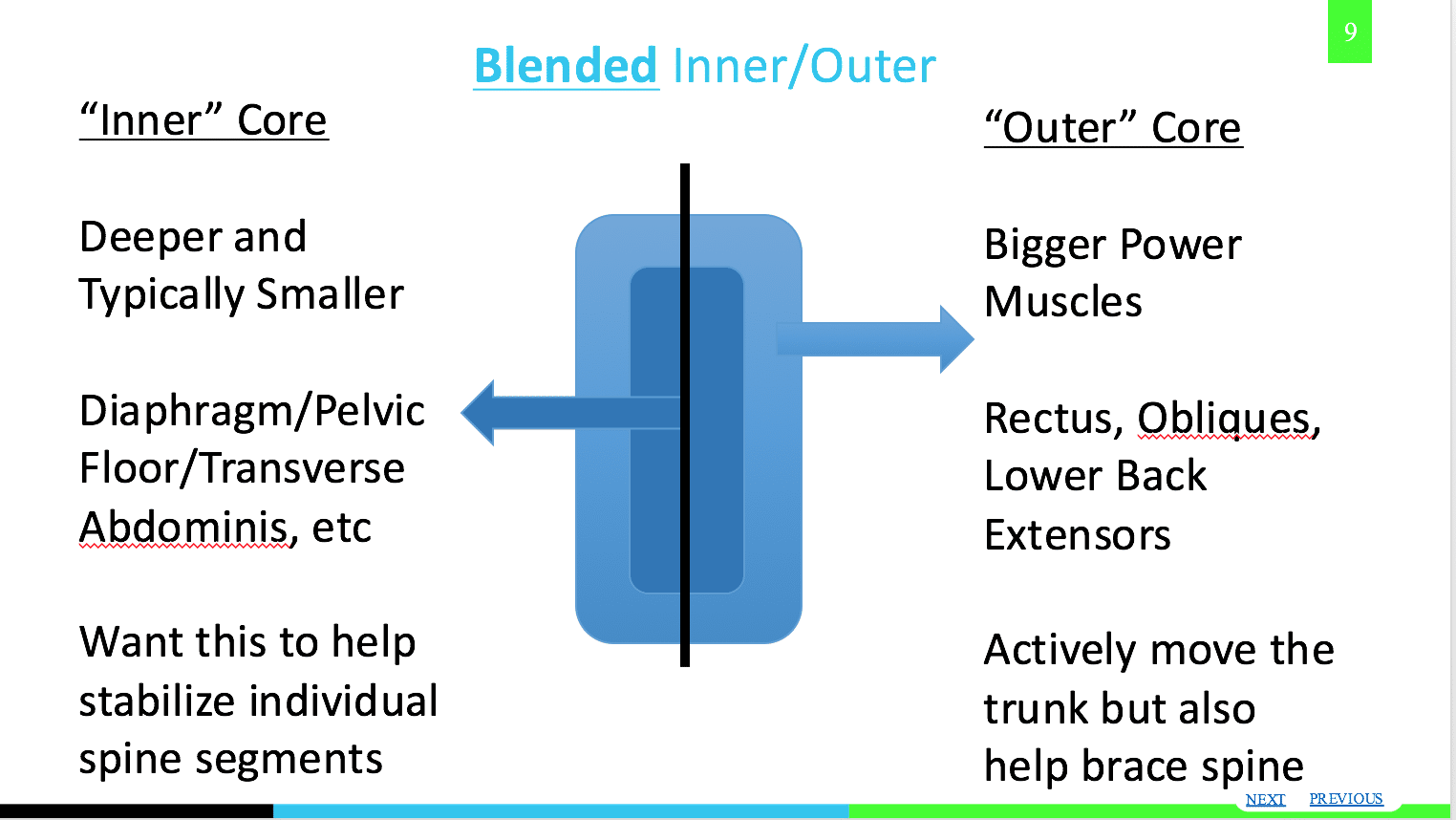
So build it into the week. A warm-up of bracing and breathing, dead bugs and bird dogs, a jump-and-land drill, and a PVC core series. Skill-specific side stations of 5–10 reps. Then conditioning circuits — one or two days gymnastics-focused (leg lifts, arch-ups) and one or two days general (suitcase carries, press-outs). My rule of thumb: aim for about a third of practice time on physical prep, scaled to how many days you’re in the gym.
Want the actual circuits, the brace-and-breathe progressions, and the demand-by-demand exercise library? This is what I go deepest on inside The Hero Lab — the hybrid core templates, the warm-up sequences, and the side-station menus you can drop into a 30-minute rotation tomorrow. Use code HEROINSIDER for 25% off your first month, and stop guessing at core day. Click HERE to learn more
— Dave
Dr. Dave Tilley, DPT, SCS, CSCS — SHIFT Movement Science
References & Further Reading
- Moeskops, S., et al. (2018). The Physiological Demands of Youth Artistic Gymnastics: Applications to Strength and Conditioning. Strength and Conditioning Journal.
- McGill, S. Low Back Disorders: Evidence-Based Prevention and Rehabilitation (3rd ed.) & Ultimate Back Fitness and Performance.
- Sonvico, L., et al. (2019). Investigation of Optimal Lumbar Spine Posture During a Simulated Landing Task in Elite Gymnasts. IJSPT.
- Boyle, M. (2016). New Functional Training for Sports.