Here’s the thing most coaches miss: a long warm-up and a good warm-up are different things. You are two to six weeks into pre-season or standing at your first meet, and the clock is tight. Fifteen minutes of random stretching and a few cartwheels will not prepare a gymnast to tumble at full speed. A short, ordered plan will.
You have probably seen the version of this I mean. The gym opens, athletes drift in, one stretches a split on the floor, another practices a cartwheel, and ten minutes later the coach calls everyone to the first event. Nothing in that sequence is terrible. It just was not planned, and a plan is what makes a short warm-up work. Below is the one I use. Read it once, then pick one “This week” action and start there.
Table of Contents
1. Going from zero to full tumbling is a cold car at 40 mph.
I use the cold car in winter to explain this. Turn it on and hit 40 mph right away, and you risk something breaking and you risk underperformance. Let it warm up for five minutes and move through the gears, and you get less risk and better performance for longer. A gymnast who walks in and runs a full tumbling pass is the first car.
A common mistake comes from this. Coaches see athletes talking, laughing and moving around the gym and assume they are warm. Being awake and being warmed up are not the same thing. A gymnast who came from school, sat in a car and then walked into the gym has not raised body temperature in a way that matters for a tumbling pass.
The research backs the analogy. Fradkin 2010 and Silva 2018 both show warm-up improves performance. Silva’s review looked at team sports, but the concept transfers: 5 minutes of jogging followed by 7 minutes of dynamic exercises improved sprint, jumping and agility performance. Silva also says to avoid a long rest after the warm-up.
Notice the two parts of that finding. The warm-up was short, and it still helped. You do not need a huge block of time. You need the right order. The second part is the rest. If athletes finish a good warm-up and then stand through a long team talk or wait in line for the first event, you give back some of what you built. Plan the handoff from the last warm-up block to the first event skill so the gap stays small.
This week: time your current warm-up from the first step to the first event skill, and count how many of those minutes raise body temperature. You may be surprised by how much of the clock goes to things that do not warm anyone up.
2. Use RAMP to build the warm-up, then run seven blocks in order.
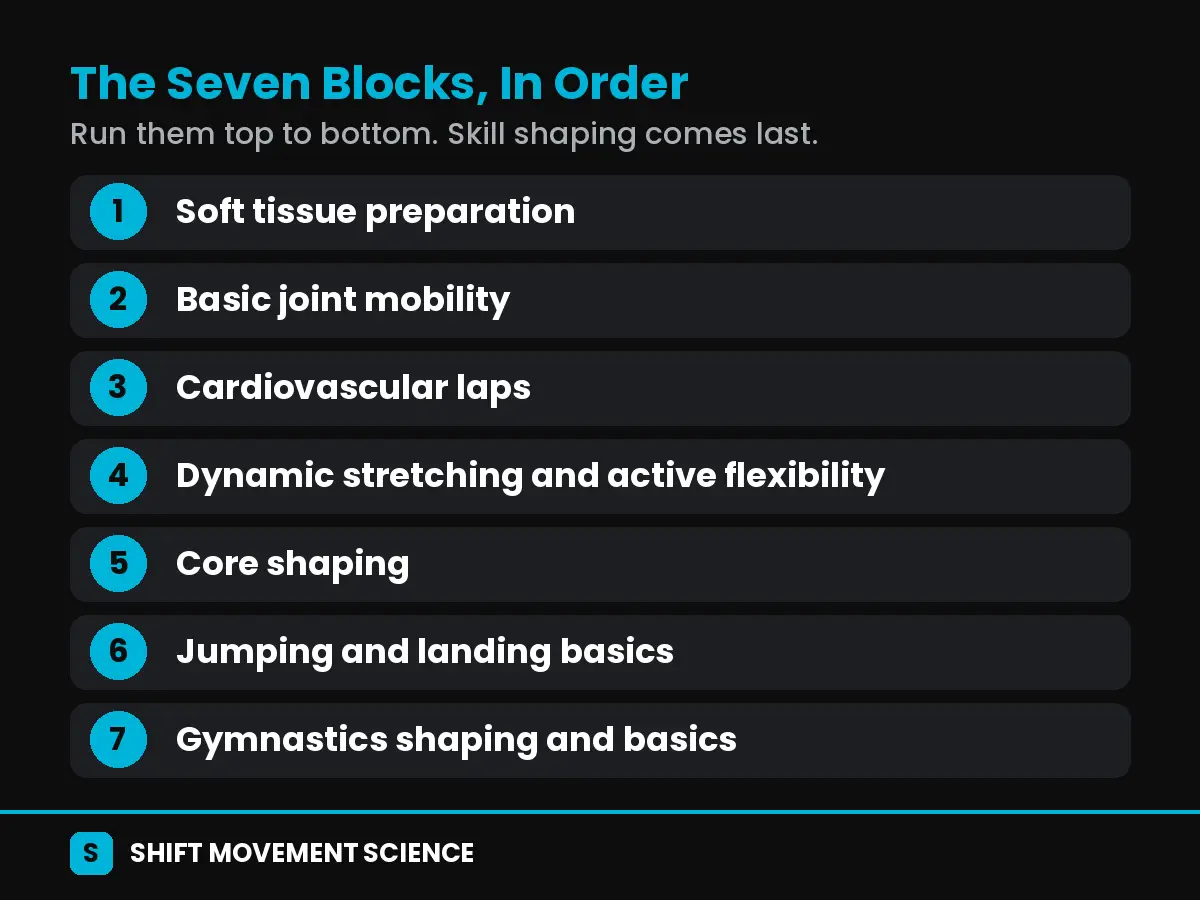
RAMP stands for range of motion, activation and movement preparation. I reference it constantly because it stops me from filling the time with whatever feels familiar. Here are the seven blocks I run, in this order:
- Soft tissue preparation
- Basic joint mobility
- Cardiovascular laps
- Dynamic stretching and active flexibility
- Core shaping
- Jumping and landing basics
- Gymnastics shaping and basics
The order matters, because going from nothing to running is a big jump. Joint mobility raises synovial fluid and blood flow before the cardio laps raise heart rate and body temperature. Dynamic work comes after that, and the skill-specific shaping comes last, once the body is ready to practice the basics of gymnastics.
Picture a coach whose team used to start with a few minutes of floor stretching and then jump into tumbling passes. Now the team starts with rolling, moves into joint mobility, jogs its laps, and only then reaches handstands and presses. Same gym, same clock, but every block sets up the one after it.
The most common mistake is skipping to the fun blocks. The fix is to put the seven blocks where everyone can see them. When the order is on the wall, nobody has to argue about what comes next, and the cardio laps stop getting traded away for extra skill time.
This week: write the seven blocks on a whiteboard in your gym and run them in order at three practices.
3. The warm-up prepares the available range of motion. Separate sessions gain range.
Something I heard once and have held onto ever since: the warm-up prepares the available range of motion, and separate flexibility sessions gain range. Warm-up preps available motion, flexibility complexes gain new motion, and strength and training solidify it. Long static stretching before events is the wrong tool, for three reasons. Gaining new flexibility in a short warm-up is tough. Using different stretching methods right before we ask for power is not ideal. And trying to gain flexibility with a large group in a general setting rarely works.
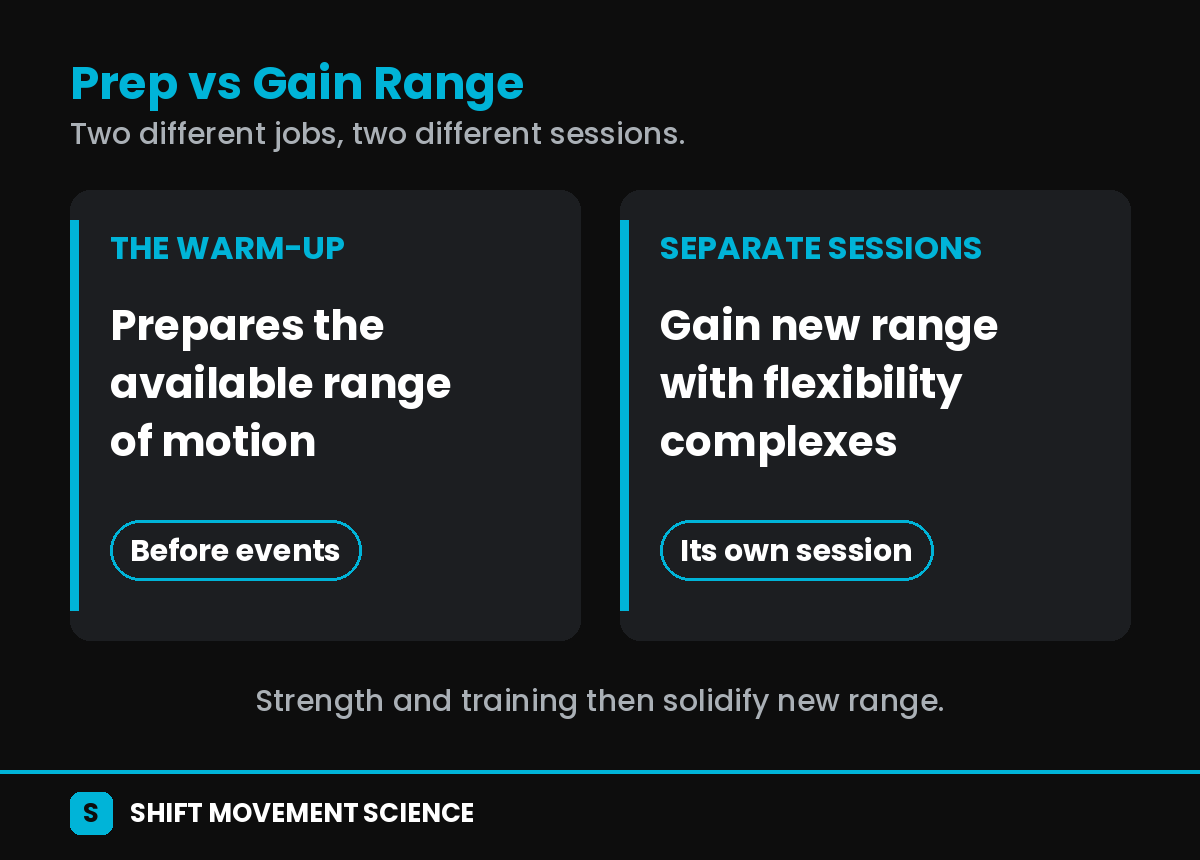
The mistake I see most is the long split hold on the floor before the first event, with the whole group lined up and everyone getting the same stretch. The fix is to give flexibility its own session where you can sort athletes by what they need, and let the warm-up do its job of preparing the range they already own.
Soft tissue work is different, and the worry that it kills power misses how practice runs. Do 30 to 60 seconds of rolling, a ball or a stick, or 30 to 60 seconds of static stretch in a position that fits the anatomy, at 3 to 4 out of 10 discomfort. Then follow it with the general warm-up. The sequence is prep, general warm-up, then event warm-up. Power only drops if soft tissue work is the only thing you do before events.
This week: move your long stretching into its own session. The free 10-Minute Gymnastics Flexibility Circuits guide gives you one.
4. Run exact laps, then compress them for the clock you have.
Here are the laps for the full version. Basic joint mobility is a half lap of wrist and neck rotations, shoulder rotations, arm swings up and out, ankle rolls, over the fence front and back, kicks front, side and back, and pike walks and duck walks.
Cardio is 2 laps: jog forward and backward back, chasse right down and left back, high skips down and low skips back.
Dynamic stretching and active flexibility is 1 lap: roll to a true quad stretch with a reach into a hamstring drill and a lat stretch, side step to lunge with an upper body turn, roll to straddle and swim to seal into an Achilles stretch, handstand to stalder down into a pike roll and hollow fall-out, and backward step, step, needle.
Core shaping is the sequence: diaphragmatic breathing x5, 3 x 10 seconds of neutral core activation, then a flat back hold and a flat stomach hold with 5 uppers, 5 lowers, 5 togethers and a hollow hold.
Gymnastics shaping is 1 lap: handstand walks with a switch halfway, 20-second line splits, pike, pancake and bridge holds for alignment, partner handstands and handstand bounces, then 3 presses and 3 back tucks.
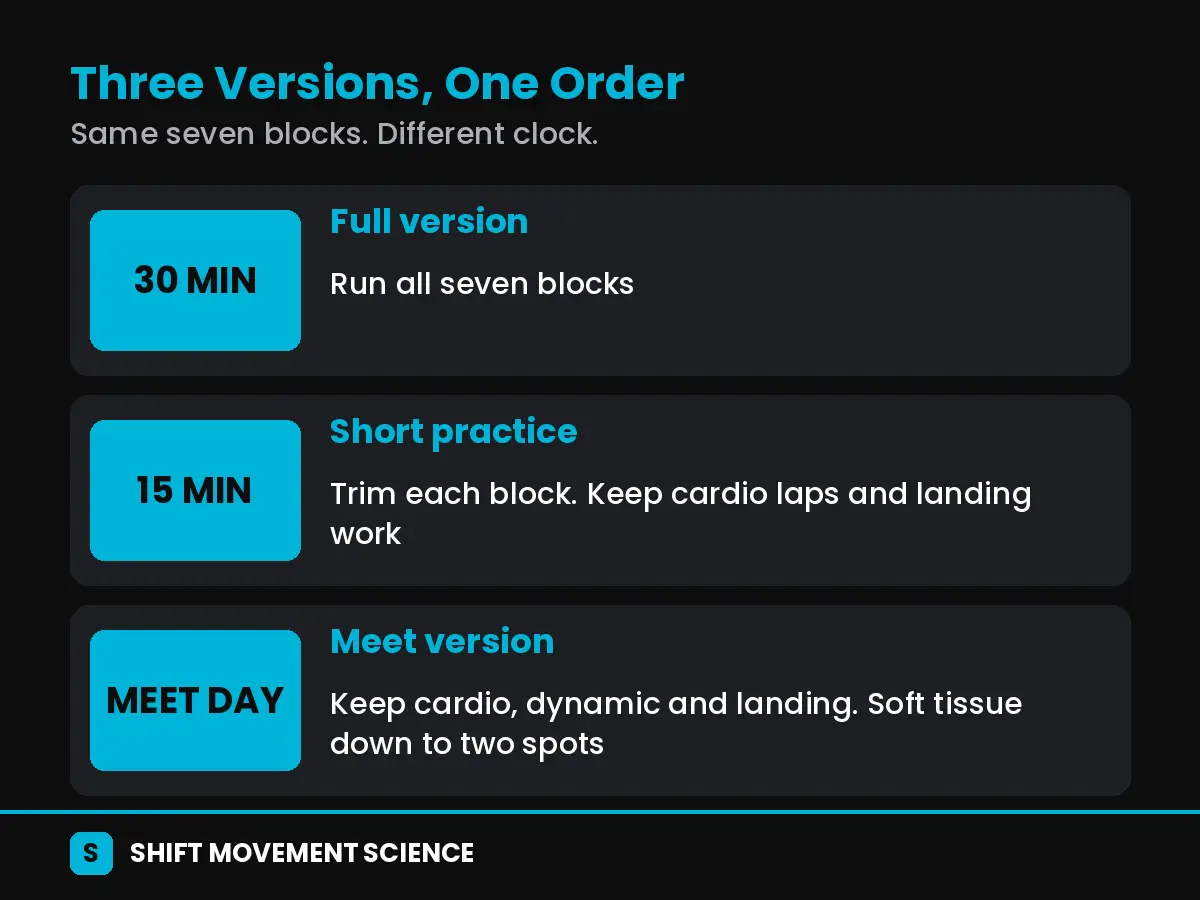
In the gym, I run the full version in 30 minutes. For a 15-minute short practice, I trim each block, keep the cardio laps and keep the landing work. On meet day, I keep the cardio, dynamic and landing blocks and cut soft tissue down to the two spots that need it.
Here is what this looks like on a Tuesday. The athletes arrive and the plan is already on the wall, so the first thing they do is roll or stretch the spots that need it. They move into wrist, neck, shoulder and ankle work, then jog the two cardio laps. The dynamic lap comes next, then the core sequence, then the landing basics, and the gymnastics shaping lap finishes with handstands, presses and back tucks. The coach is not inventing anything on the spot, because the decisions were made before anyone walked in.
The mistake with a short practice is cutting the wrong things. When the clock shrinks, the cardio laps and the landing work are the first things coaches drop, because they do not look like gymnastics. Those are the two blocks I keep. Trim the length of each block instead, and keep the order.
This week: pick your 30-minute and 15-minute versions now, so you do not decide at the gym door.
5. Do landing basics every day, because gymnastics is a jumping and landing sport.
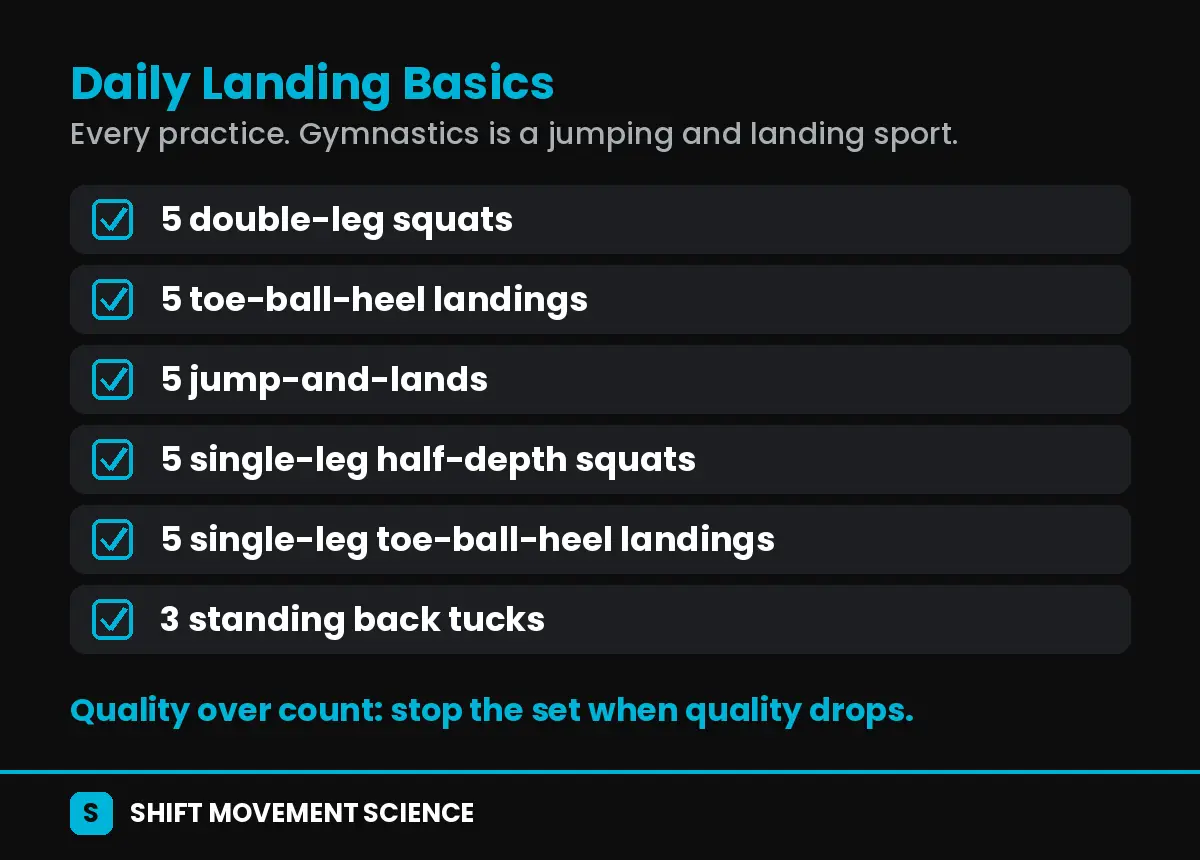
The injury statistics are terrifying, and neuromuscular training programs have been reported to reduce ACL tears by about 67%. That is why landing basics are a daily block, not an extra for the hard days. The sequence is short:
- 5 double-leg squats
- 5 toe-ball-heel landings
- 5 jump-and-lands
- 5 single-leg half-depth squats
- 5 single-leg toe-ball-heel landings
- 3 standing back tucks
The standing back tucks do double duty as a gymnastics basic and a landing rep. Coach quality, not only count. I would rather see 5 clean toe-ball-heel landings than 15 sloppy ones, and I stop the set when quality drops.
The common mistake here is treating the sequence like a box to check. Athletes rattle through the reps while the coach is across the gym, and nobody looks at the knees. The fix is to watch every rep of the single-leg work, call out what you see, and stop the set when the landings get sloppy.
This week: add the sequence to every practice and name one coach to watch knee position on every rep of the single-leg work.
Coach questions I hear most
Will rolling before practice kill my gymnasts’ power? Not when it is a short prep step. Keep it to 30 to 60 seconds, follow it with the general warm-up, and power only drops if soft tissue work is the only thing you do before events.
Where do I put long stretching? In its own session. The warm-up prepares the range athletes already have, and separate sessions are where they gain new range.
Put this into practice
Monday, write the seven-block order down and time your current warm-up. Tuesday and Wednesday, run the full 30-minute version and move long stretching into its own session. Thursday, run the 15-minute version, and Friday, plan your meet-day version with soft tissue cut to two spots. Run the landing sequence every day. When you start planning the season backward from your meets, build the warm-up in first. It’s just gymnastics, but a written warm-up beats improvising at the gym door every time.
Want the actual programs, not just the framework? This is what I go deepest on inside The Hero Lab: the full warm-up lecture and video, and the Flexibility Blueprint course for gaining range outside the warm-up. Use code HEROINSIDER for 25% off your first month.
— Dave
Dr. Dave Tilley, DPT, SCS, CSCS
References & Further Reading
- Fradkin AJ, Zaryn TR, Smoligo JM. Effects of warming up on physical performance: a systematic review with meta analysis. 2010 JSCR
- McGowan CJ, et al. Warm Up Strategies for Sport and Exercise: Mechanisms and Applications. 2015 Sports Med
- Silva LM, et al. Effects of Warm Up, Post Warm up, and re-Warm Up Strategies on Explosive Efforts in Team Sports: A Systematic Review. 2018 Sports Med
- Wittekind AL, Beneke R. Metabolic and performance effects of warm up intensity on sprint cycling. 2011 SJMS
- Cheatham, et al. The Effects of Self Myofascial Release using a Foam Roll or Roller Massager on Joint Range of Motion, Muscle Recovery, and Performance: A Systematic Review. IJSPT 2015
- Beardsley C. Effects of self myofascial release: A Systematic Review. 2015 JBMT
- Reinold, Andrews, Wilk. The Athlete’s Shoulder. 2009
- Nho, et al. Hip Arthroscopy and Preservation Surgery. 2016
- Noyes F. Knee Disorders. 2009
- McGill S. Low Back Pain Disorders. 2007
- Sale, Dugby. The Physiology of High Performance. 2016 Oxford
- Cardinale, Newton, Nosaka. Strength and Conditioning: Principles and Biological Applications. 2015
- Haff. Essentials of Strength and Conditioning. 2013
- Tudor, Comfort. Strength and Conditioning: An Evidence Based Approach. 2018
- Lloyd. Strength and Conditioning for Youth Athletes. 2016
- Joyce, Lewindon. Sports Injury Prevention and Rehabilitation. 2017