

Most season plans get built forward. Pre-season starts, a coach maps out what feels reasonable for October, figures out November when November arrives, and by February the plan is really just “whatever last week was, plus a little more.” It’s not negligence — it’s just the natural drift of planning one week at a time.
The fix isn’t more effort. It’s a different starting point. Start from the biggest meet of the year and work backward. Year, then month blocks, then week blocks, then the individual week, then the day, then the individual assignment. Every one of those levels should trace directly back to the date on the calendar you actually care about.
This week I want to walk you through exactly how to do that, using a full worked example — a 6-month season, October through March, built backward from a biggest meet at the end of March. Adapt the dates to your own calendar; the structure is what matters.
Table of Contents
Step 1: Find the anchor date
Everything starts with one date: the biggest meet of the year. For this example, let’s say it’s the last weekend of March — a state or regional championship. That single date becomes the anchor every other decision gets measured against.

Once you have it, count backward in three phases:
- Off-season / general prep — the furthest point from competition, where you build the broadest base.
- Pre-season / specific prep — where general capacity converts into event-specific skill and volume.
- In-season / competition prep — where volume peaks and taper brings the athlete to the anchor date fresh.
For our 6-month window, that breaks into month blocks like this:
| Month | Phase | Primary Focus |
|---|---|---|
| October | Pre-season base | Skill consolidation, Daily Dozen, aerobic conditioning base |
| November | Pre-season build | Half-routine volume, strength maintenance, burst conditioning |
| December | Transition | Half-routines → first full routines, event-specific strength |
| January | Competition prep 1 | Full routine volume building, in-season intensity distribution |
| February | Competition prep 2 | Peak volume, meet simulation, routine consistency |
| March | Taper & peak | Volume drops, intensity holds, freshness for the anchor meet |
Notice the shape: volume and specificity climb steadily from October through February, then volume drops sharply in March while intensity stays relatively high — that’s a taper, not a shutdown. You are always managing gymnastics performance, strength, conditioning, and athlete wellness simultaneously across every one of these blocks; only the emphasis shifts.
Every October injury wave I’ve ever seen was planned three weeks earlier — nobody just meant to.
Step 2: Build the loading wave inside every month
Within each month block, use a 3+1 loading wave: three weeks of building load, one week of deload. Label the three build weeks by their intent, not just their number:
- Week 1 — Learn/Load. Introduce anything new (a skill, a conditioning format, a routine structure) at moderate volume so the body and the skill both have room to adapt.
- Week 2 — Load. Push volume and/or intensity up from week 1.
- Week 3 — Load. Push again — this is typically the highest-load week of the four.
- Week 4 — Deload. Volume drops noticeably. This is not a wasted week; it’s where the previous three weeks of stress actually convert into adaptation.
This wave repeats across the whole 6-month arc — six months at roughly four weeks each gives you six of these 3+1 cycles between October and March, which is also why the taper month (March) breaks the pattern on purpose: it’s a deliberate deload-adjacent month, not a normal build cycle.
Ramp between weeks — including from week to week inside a 3+1 wave — should run 5-10% growth in total training demand, not more. That’s hours and intensity together; a gym can hold hours completely flat while quietly doubling difficulty, and that’s still a spike even though the schedule looks unchanged on paper. A 5-10% climb, applied consistently, is what actually gets a gym from summer hours to full pre-season load over the standard 5-6 week runway — and it’s the same math that should govern every climb after that, month over month, all the way to peak.
Step 3: Rotate intensity across the training week
Inside every individual week, distribute intensity so fatigue never piles up unchecked across consecutive days. For a 6-day training week, the target distribution is:
- 3 heavy days
- 2 medium days
- 1 light day
These can scale to 5, 4, 3 day training weeks as well.
5 days might have 2 heavy, 2 medium, 1 light.
4 days may have 2 heavy, 1 medium, 1 light.
3 days might have 2 heavy, 1 light.
Spread the heavy days apart rather than stacking them — a common, effective pattern is heavy on the first day back, medium mid-week, heavy again, light before the next heavy block starts. Strongly avoid slamming a heavy day first thing Monday if the athlete is carrying accumulated fatigue from the weekend; that just digs a hole for the rest of the week. Let the light day function as genuine recovery, not a slightly-easier heavy day in disguise.
This same 3-heavy/2-medium/1-light logic scales down for gyms training fewer days — five days becomes 2 heavy/2 medium/1 light, four days becomes 2 heavy/1 medium/1 light — but for this worked example we’ll stay with a standard 6-day competitive gymnastics week.
Step 4: Progress skills → half-routines → full routines
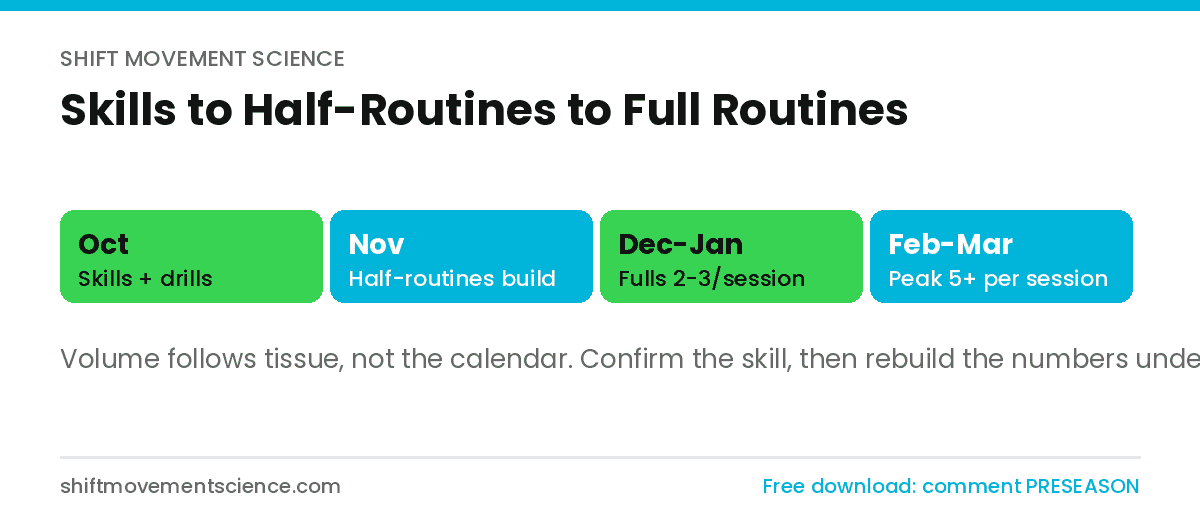
This is the piece that trips up the most programs, because skill readiness and routine-volume readiness return on different timelines. An athlete can hit a skill clean in isolation within a week or two of resuming it — skill and coordination come back fast. Tissue capacity to absorb that skill dozens of times in a routine context takes far longer to rebuild. Confirm the skill first, at low volume, before asking the body to repeat it at routine density.
Here’s how that plays out across our worked 6-month arc:
October (skill consolidation): Skills trained individually, low rep counts, 1-2 clean reps to confirm each skill is present and safe before it goes anywhere near a routine. No routine volume yet.
November (half-routine volume building): This is the 8-week window — spanning late October into November — where half-routines (roughly the first or second half of a full routine, run as a connected sequence) become the main volume driver. Start with 2-3 half-routines per session in week 1 of the block and build toward 4-6 half-routines per session by the end of the 8 weeks, following the same 5-10% weekly climb as everything else. This is where connected-skill capacity — not just isolated-skill capacity — actually gets built.
December (transition to full routines): First full routines appear here, deliberately kept low: 2-3 full routines per session to start the month. The half-routine volume built in November doesn’t disappear — it continues at a maintenance dose alongside the new full-routine work, because full-routine count alone isn’t enough repetition to hold the skills inside it sharp.
January (competition prep, volume building): Full routine counts climb through the month, following the 5-10% weekly ramp, moving from roughly 3 up toward 4 routines per session by the end of the month.
February (peak volume): This is peak. Full routine counts reach 5 or more per session, run at or near competition intensity, often including full meet-simulation days where routines are performed back-to-back under simulated pressure.
March (taper): Full routine count drops back down — often to 2-3 per session — while intensity per routine stays high. This is what a taper actually looks like: less total work, similar or slightly higher quality per rep, so the athlete arrives at the anchor meet fresh instead of fatigued.
| Month | Skill work | Half-routines/session | Full routines/session |
|---|---|---|---|
| October | 1-2 reps/skill, isolated | — | — |
| November | Maintenance | 2-3 → 4-6 (building) | — |
| December | Maintenance | Maintenance | 2-3 (introduced) |
| January | Maintenance | Maintenance | 3-4 (building) |
| February | Maintenance | Maintenance | 5+ (peak) |
| March | Maintenance | Maintenance | 2-3 (taper) |
The programs that get pre-season right walk into competition season from the penthouse. The ones that wing it walk in from the basement.
Step 5: Sanity-check the whole arc
Before you commit this to a whiteboard or a shared calendar, run it against three questions:
- Does every month trace back to the anchor date? If you can’t explain why February looks the way it does in terms of what March needs, the block isn’t backward-planned yet — it’s just forward planning with a nicer table.
- Does volume ever climb more than 5-10% in a single week? Check both hours and difficulty. A flat-hours week with a jump in skill difficulty is still a spike.
- Is there a deload every fourth week, without exception? The 3+1 wave only works if the deload week actually happens — skipping it because “we’re behind” is exactly how the load spike that causes a three-to-four-week-later injury gets built in.
Run this tomorrow
- Write your anchor date on the wall — the actual date of your biggest meet — and count backward into month blocks before you plan another single week.
- Label your current week inside its 3+1 wave: is this a Learn/Load week, a Load week, or a Deload week? If you can’t answer that in five seconds, the wave isn’t being tracked.
- Audit this week’s intensity distribution against the 3-heavy/2-medium/1-light target for a 6-day week. Two heavy days back-to-back on Monday and Tuesday is a common, avoidable mistake.
- Check your half-routine and full-routine counts against where you are in the arc. If you’re running 5 full routines a session in November, you’ve skipped the runway the tissue needs.
Get the full system
1. Free download — The 25-Box Pre-Season Checklist. Backward planning is one box in a complete 25-box system covering culture, workload, strength, conditioning, and wellness. If you want my full preseason checklist just drop your email here!

FREE Gymnastics
Pre Season Checklist
Gymnastics season is coming quickly! Get my "must-have" tips to set up your best competition year yet.
2. Free course. For the complete framework behind every piece of this 6-week series, take the free course at shiftmovementscience.com/freecoaches/.
3. The Hero Lab. If you want done-for-you periodization templates, monthly loading calendars, and direct programming support, join The Hero Lab. Use code HEROINSIDER for 25% off your first month.
References
- Gabbett, T. — Acute:chronic workload ratio and the training-injury prevention paradox.
- Mujika, I. & Padilla, S. — Detraining and the differing recovery timelines of aerobic/strength capacity versus skill and coordination.
- Bompa, T. & Buzzichelli, C. — Periodization: Training for Sports.
- Haff, G. & Triplett, N.T. (eds.) — NSCA’s Essentials of Strength Training and Conditioning.