

Your culture does not get built in pre-season. It gets tested right now, in the weeks between the first meet and the state meet, when the stress goes up and every habit shows. I wrote a free e-book, “Changing Gymnastics Culture,” that around 10,000 coaches have downloaded, and the same lesson runs through all of it: culture is what your gym does under pressure. Here’s the thing most coaches miss: you can still change it mid-season.
Think about the last meet where something went sideways. A routine fell apart, a parent got loud, two coaches snapped at each other. Nobody planned those moments, and nobody rehearsed them either. That is exactly why they tell you so much. This post walks through where culture breaks under meet-season stress, and what you can do about it this week, not next season.
Table of Contents
Meet season is the stress test, and the five layers show you where it breaks.
In my lecture on changing a gym’s culture, I lay out the signs side by side. An unhealthy gym has low motivation, bickering and gossip, no communication about real issues, high injury and burnout rates, no progress toward goals, and frustrated people. A healthy gym makes progress even during adversity, communicates openly, handles issues with professionalism and respect, addresses injuries directly with health first, values progress over perfection, and stays upbeat. Meet season exposes every one of these within a month. Use the five layers as your map: you, one-on-one, group, inter-group, and the gym itself, your “tribe.” Find the layer where your gym is breaking. My free Gymnastics Culture and Personal Development Guide gives you the checklist.
Free download: Gymnastics Culture and Personal Development Guide

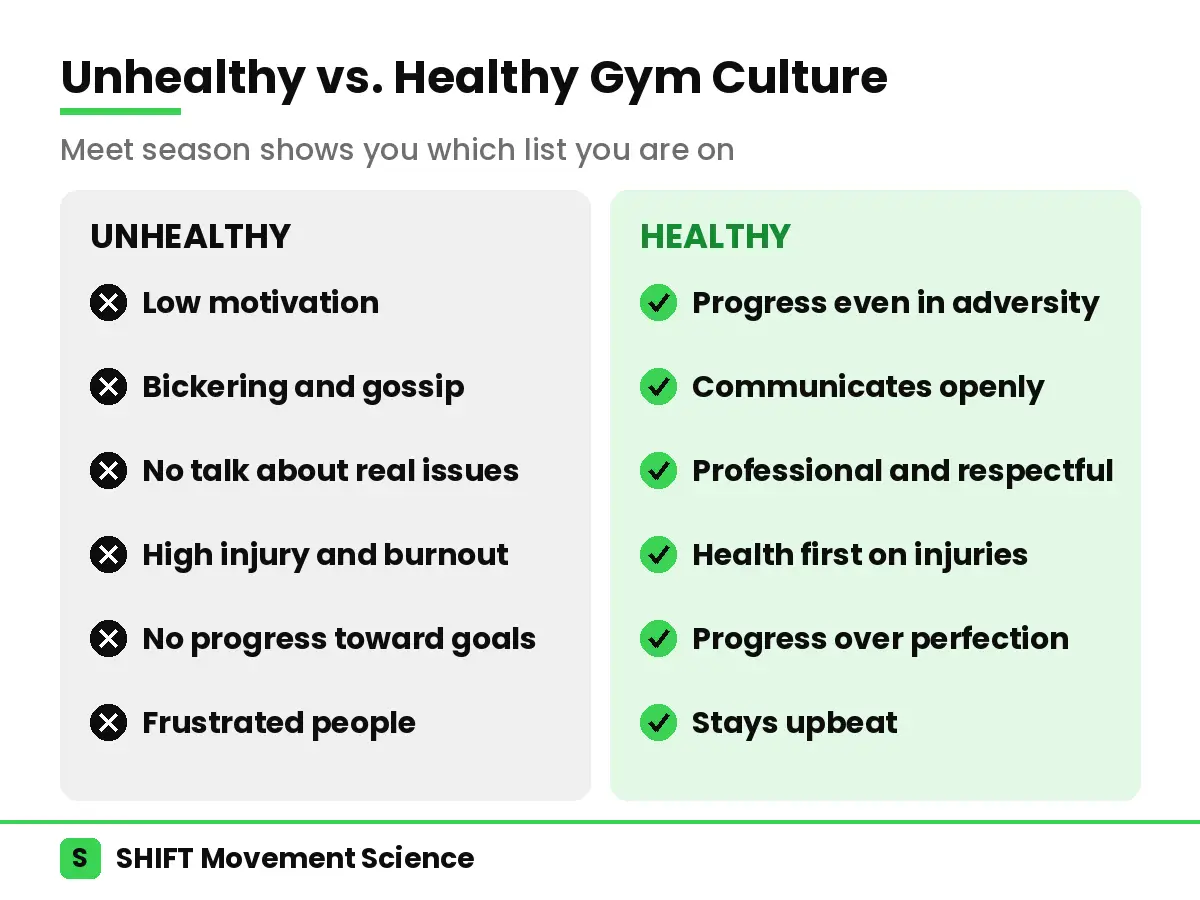
Most gyms are not all one or the other. You will probably see signs from both lists in the same week, and that is normal. Name what you see so you know where to start.
Here is how I think about the five layers on a meet weekend. Layer one is you: how you react when a routine goes badly. One-on-one is the quiet conversation with a single athlete at the edge of the floor. Group is the huddle between events. Inter-group is how your levels treat each other in the stands. The gym itself, your tribe, is what parents, officials and rival coaches see when they look at your team.
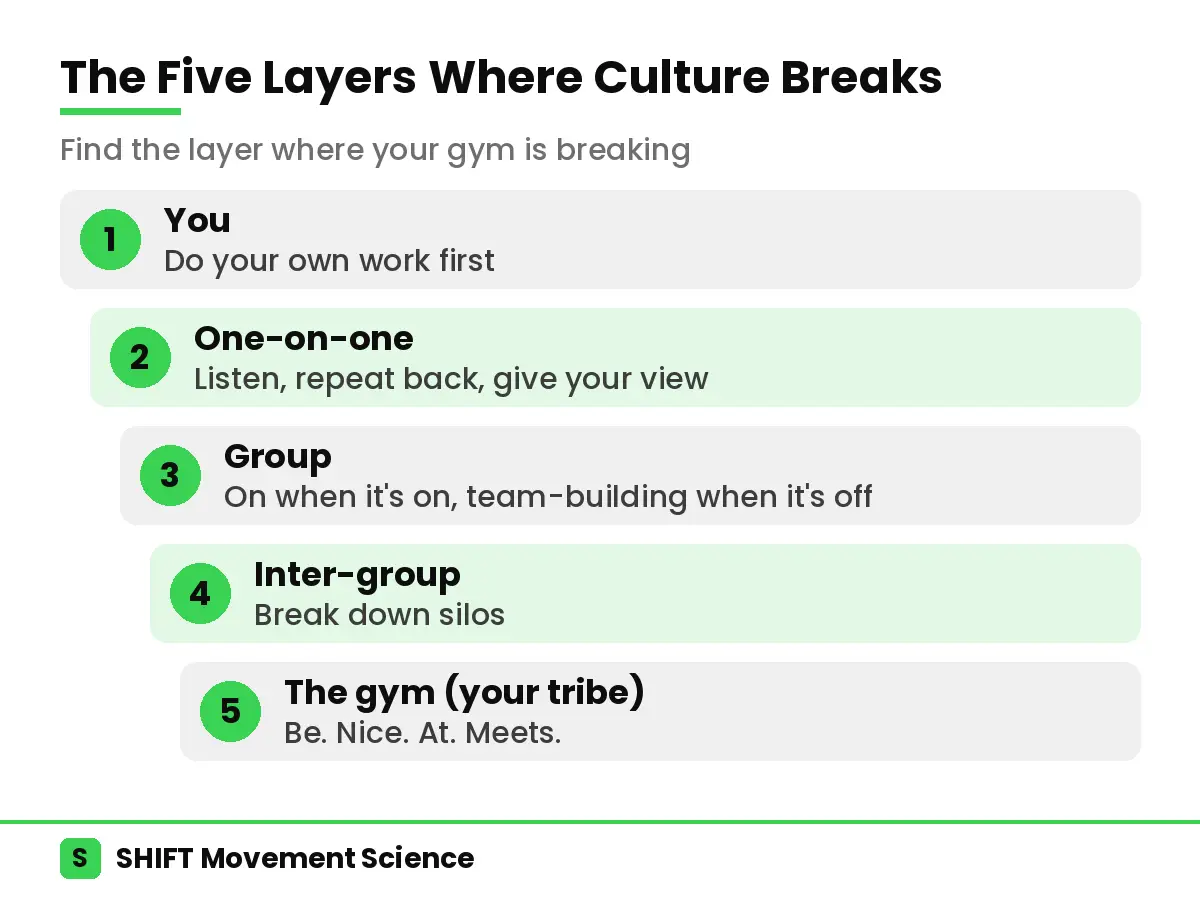
Common mistake: trying to fix all five layers at once. You end up with a long list, a tired staff and no real change. The fix: pick the one layer where problems show up most often, and make one small change there before you touch anything else.
This week: Read both lists at your next coaches meeting and mark which layer each problem lives in.
Layer one is you, so do your own work before you ask anything of the athletes.
This layer is the hardest one. Everyone looks outward to blame and fix, and looking at yourself is the key. I strongly suggest journaling for a week on four questions: Why am I involved in gymnastics? What are my values? Do my daily choices align with those values? What are my fears and insecurities? My own shift moved from status, attention and praise toward humility and relationship building, and from fear of social judgment toward acceptance and work. Then ask one close friend for honest feedback, commit to small changes, and go easy on yourself while you do it. In the gym I see coaches skip this step and then demand a better attitude from kids who copy exactly what the coach models.
Here is a meet-day picture of why it matters. A gymnast misses her beam routine and walks toward you. You feel your jaw tighten because you worry what the other coaches think of your team. She sees that face before she hears a word. If your fear of judgment is running the show, she learns that mistakes make the coach upset, and she will hide the next one. If you have done the work, you can take a breath and meet her with something useful.
Common mistake: asking someone who will only tell you what you want to hear. The fix: choose the friend who cares about you enough to say the true thing kindly, and then thank them instead of defending yourself.
This week: Journal on the four questions for seven days, then ask one close friend how you come across at meets.
Micro-events decide the season, and listening is the foundation.
Small daily interactions build trust, and the foundation is listening: “the lowest level of listening is waiting to speak.” Ask yourself what your first verbal and nonverbal response is when:
- A fellow coach critiques you at a meet.
- A gymnast says her wrist hurts in warm-up.
- A gymnast is scared of a skill the week before a meet.
- A group is talking instead of doing assignments.
- A parent approaches you after a bad meet.
Your answers show your values. Respond in four steps: listen with an open mind, repeat the key points back, give your view, and critique the behavior, not the person. Never escalate.
Take the wrist example. A gymnast says it hurts in warm-up, and the meet starts in an hour. Step one, listen: stop what you are doing, face her, and let her finish. Step two, repeat it back: “So your wrist started hurting during warm-up, and you are worried about telling me.” Step three, give your view: “I’m glad you told me. Health comes first, so let’s look at it together.” Step four, critique the behavior, not the person: “Telling me right away was the right call.” That is how injuries get addressed directly.
Chalk bucket, old me, shouting across the gym: “Girls, get out of the chalk bucket, you’re driving me nuts. Kelsey, don’t be lazy.” Updated me, calm: “I’m a little frustrated. You told me you want these new skills. Talking instead of doing drills isn’t showing that. If you don’t want that choice, I’ll ask you to go somewhere else.” My biggest advice: ask about and care about the non-gymnastics stuff.
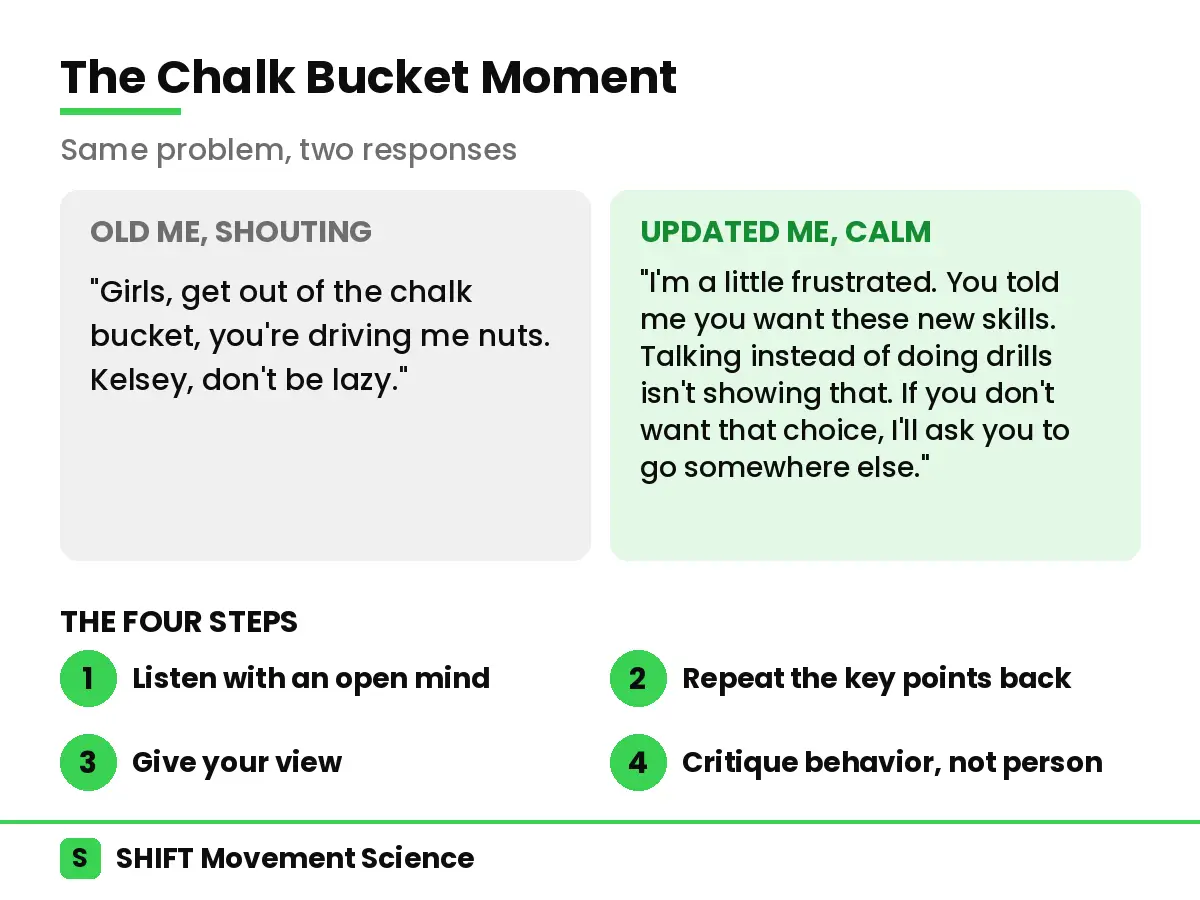
Why does the updated version work? I name my own feeling instead of attacking someone. I tie the moment to something the athletes told me they want. I describe the behavior, talking instead of doing drills, and not the kid. Then I offer a clear choice. The old version calls out one gymnast with a label, and everyone else learns to keep their head down.
This week: Ask every athlete one non-gymnastics question before warm-up.
Group and inter-group time is a performance tool, not fluff.
Social support is one of the biggest buffers against stress, and so is a sense of control and of being heard. Meet season hands your athletes a lot of stress and very little control. That does not mean a free-for-all. Miss Val’s “on/off” idea applies: when practice is on, it is fully on, and when it is off, you build the team. Stick-it contests and team movie nights do that work. At the inter-group layer, break down silos, which comes from the book Team of Teams. Make family guidelines together, mix coaching groups, run big and little sister programs, hold team game nights, plan charity events, and show up to support other levels’ sessions at meets. This applies to your coaching staff too, so the coach of the youngest group should know the plan for the oldest.
Here is what on/off can look like in a meet-week practice. The first part of practice is on: assignments, full attention, clear standards. Near the end, practice is off, and you run a stick-it contest where the whole group cheers each landing. The athletes get a break from pressure, they get to be heard, and they leave knowing teammates are on their side.
Common mistake: cutting every fun team activity because the meet is close. The fix: keep a short, planned “off” block.
This week: Schedule one team game night between the next two meets and pair each older athlete with a younger one.
Be nice at meets, because your culture code goes into the arena with you.
The tribe layer comes down to four words: Be. Nice. At. Meets. Carry your culture code with you, because your daily choices reflect your values, and the arena shows them to everyone. Miss Val says it best: “Our job is to create champions of life through sport.” Your sideline behavior toward athletes, officials, parents and rival coaches either proves that line or breaks it. If you want the logistics side, use the four-week meet checklist. My parting plan has five steps: work on yourself first, hold a coaches meeting and be ready for tough conversations, hold an athlete meeting, make a plan with small changes, and never stop working on it.
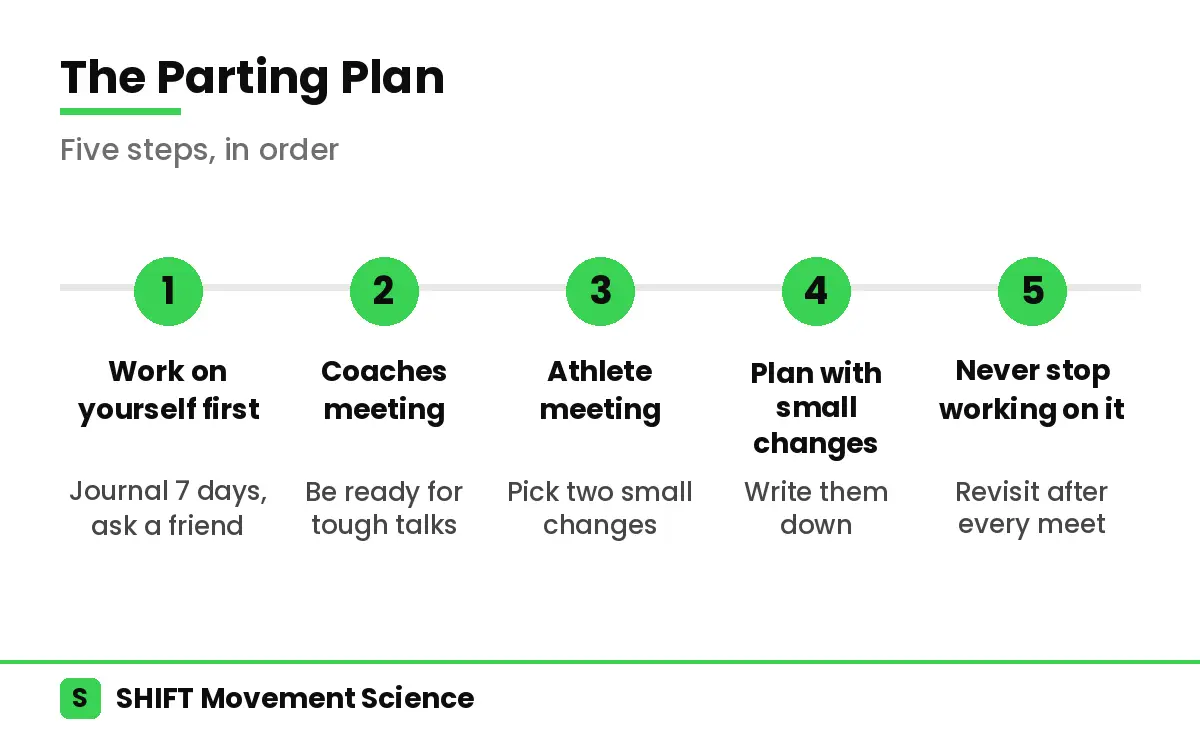
Picture the sideline at the next meet. A judge scores your athlete lower than you expected. A rival coach’s gymnast falls and the room goes quiet. A parent from your own gym is upset. Each of those is a chance to show your code. Stay calm with the official, kind to the rival’s athlete, and steady with the parent. Your athletes will copy what they see.
This week: Put the coaches meeting on the calendar before your next meet.
Coach FAQs
Is it too late to change culture once meet season has started? No. Meet season is where culture shows, which makes it the best time to see what needs work. Start with one layer and one small change.
What if my coaching staff does not buy in? Begin with layer one. Do your own work and model the listening steps. Then bring the two lists to a coaches meeting and ask where each person sees the gym breaking.
Put this into practice
Start the journaling week today. By Thursday, ask one close friend for honest feedback. Hold the coaches meeting before your next meet, bring the unhealthy and healthy lists, and have the tough conversations there. Then meet with your athletes, pick two small changes, and write them down. Put a team game night on the calendar and revisit the plan after every meet through states.
Want the actual programs, not just the framework? This is what I go deepest on inside The Hero Lab: the full culture and coaching lecture series, and the communication scripts for coaches and parents. Use code HEROINSIDER for 25% off your first month. And a heads up: the Black Friday bundles and the $90 Hero Lab yearly plan open November 24, and anyone who has bought from SHIFT before gets in early on November 20.
— Dave
Dr. Dave Tilley, DPT, SCS, CSCS
References & Further Reading
- McChrystal S, Collins T, Silverman D, Fussell C. Team of Teams: New Rules of Engagement for a Complex World. Portfolio 2015.
- Kondos Field V. Life Is Short, Don’t Wait to Dance. Center Street 2019.
- Tilley D. Changing Gymnastics Culture (free e-book). SHIFT Movement Science.
- Tilley D. Advice From the Trenches on Changing a Gym’s Culture. Lecture, SHIFT Movement Science.