

Four weeks before the first meet, the most useful thing you can do is stop adding. Every November I watch teams add a new skill, a longer routine and a harder conditioning block in the same week, then wonder why two athletes limp into the meet. The problems I covered in pre-season pitfalls land on the calendar exactly where you are right now. Here is the checklist I run in the gym.
There are five steps, and each one ends with a “This week:” action you can do at your next practice. Read the whole thing once, then work through it one step per day. None of it needs new equipment or a new program. It needs a calendar, a clipboard and the discipline to leave your plan alone once it is written.
Table of Contents
Lock the routine four weeks out, then build it on a 3+1 wave.
Four weeks from the meet, stop adding skills. The routine on the floor today is the routine you compete. From there, progress from isolated skills to half-routines to full routines, and run the block on a 3+1 wave: three weeks building, one lighter week. If you have not mapped the calendar yet, plan the season backward from the meet date and fill in the weeks.
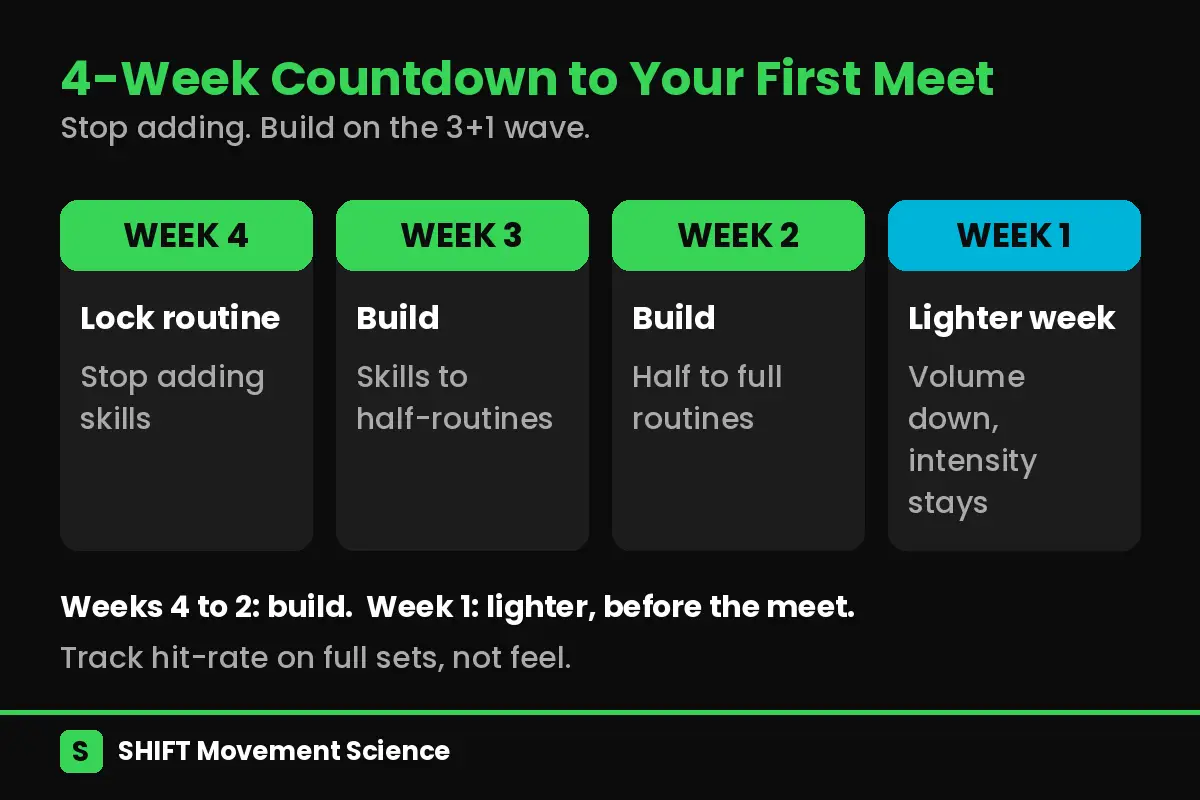
Here is how that looks in a real practice. Picture a coach with an athlete who is two weeks into learning a new dismount, and suddenly it ‘clicks’ for her. There is a temptation is to squeeze it in because she it ready. The better call is to leave the dismount for after the meet and spend those four weeks making the current routine boring. Boring is the goal. A routine that is boring in practice is calm in the arena.
Here’s the thing most coaches miss: how a routine feels tells you very little. In the gym I use hit-rate on full sets, not feel. Tired athletes feel terrible and hit. Fresh athletes feel great and fall. Also remember that an athlete who has only done skills since summer should not be taking full routines and hard landings within two weeks.
The most common mistake here is changing the routine “just a little” in week three. A new connection, a different acro sequence, a tweaked dance element. Every small change resets the athlete’s confidence and adds a new thing to miss. The fix is simple to say and hard to do: if it was not on the sheet four weeks out, it waits for the next meet.
This week: write the locked routine for every athlete on one sheet, and start a hit-rate tally of full routines attempted and hit. I like to call this an “A routine” or a “Base set,” and it might not have everything an athlete needs, but what it does have is consistency and confidence, which is the key for the start of season.
Raise one dial at a time, because load spikes are where athletes break.
Acute load is one week of volume times intensity. Chronic load is the rolling four-week average. When this week climbs sharply above that average, performance drops and injuries show up. The IOC consensus statements (Soligard et al., 2016) and Gabbett (2016) make the same point: injury rates rise after reduced training, when competitive routines start, and just before and during competition.
That is why November is dangerous. Routines begin, landings get harder, and coaches raise strength and conditioning intensity in the same week. Three dials moved at once is the classic mistake, and it is a plan problem, sometimes an ego problem. Do not start the final block with your foot on the gas.
Think of the three dials as routine volume, landing intensity and conditioning intensity. In a typical gym, the week full routines return is also the week the team starts harder landings and a tougher conditioning block, because everyone is excited and the calendar feels tight. The athlete’s body gets three new demands at once and has no way to tell you which one tipped it over.
The fix is to sequence them. If routines go up this week, hold conditioning where it is. If conditioning has to climb, let routine volume sit still. You are not lowering your standards. You are making sure that when something goes wrong, you know which dial caused it.
This week: compare your planned hours and intensity to the last four weeks. If routines go up, hold strength and conditioning intensity where it is.
Taper without shutting down, because adaptation happens in recovery.
Athletes adapt between sessions, not during the hard one. So the taper before your first meet is not a shutdown. Volume comes down, intensity stays. The lighter week you built into the 3+1 wave belongs right here, in front of the meet, so athletes arrive fresh and still sharp.
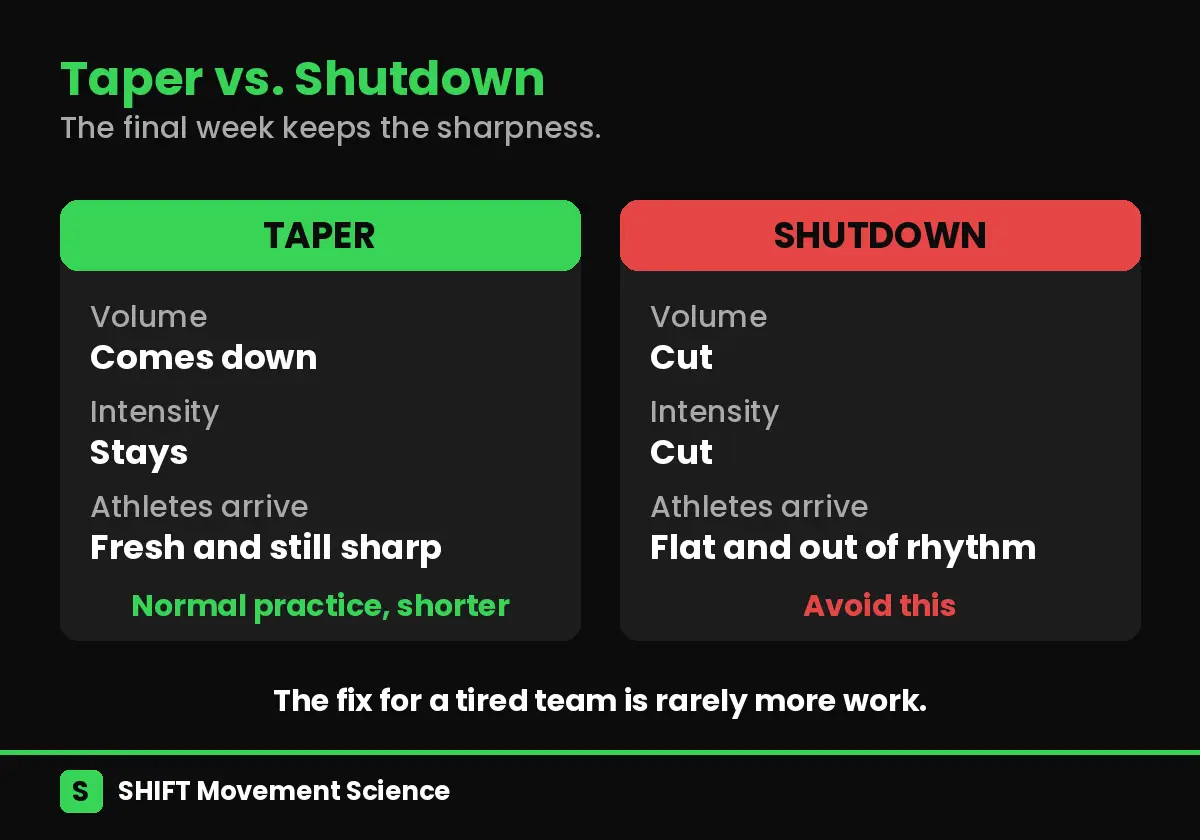
A shutdown looks like cancelled practices, no tumbling and a team that sits around the gym in the final week. A taper looks like a normal practice that is shorter. The athletes still do their routines, still land their skills and still hit the speed and effort they will need on meet day. They just do fewer reps, so they leave the gym with energy left.
I see two mistakes in the final week. The first is the panic cram: a coach feels the meet is close, so she adds extra sets “to be safe.” The second is the over-correction: she cuts everything, and the athletes show up flat and out of rhythm. Both come from distrust of the plan. If you built the work in the first three weeks, the lighter week is where it pays off.
Sleep, fueling and soft tissue care are team habits, and pre-season is when you build them. Dr. Bill Sands makes recovery the center of the conversation, and the message holds: skip it and fatigue accumulates, overtraining follows and injuries snowball. The solution looks nothing like the problem. The fix for a tired team is rarely more work.
This week: put the lighter week on the calendar, then set one team standard for sleep and one soft tissue block at the end of practice.
Monitor the response, because the plan only tells you what you did.
External load is what you prescribed: hours, skills, routines. Internal load is how the athlete responded, physically and mentally. Have athletes log daily: RPE, soreness, fatigue, hours of sleep and resting heart rate. I also track attendance and growth.
The log is the only way to see the gap between those two. Two athletes can do the same practice and walk out with very different internal loads. One had a full night of sleep and a good dinner. The other slept poorly and skipped lunch. Without a log, you treat them the same and one of them pays for it.
Read the log for two patterns. Overreaching looks like high soreness, high fatigue and an elevated resting heart rate. Underreaching looks like no soreness after a heavy day, which tells you the day was not as hard as you thought. Either pattern is a reason to adjust before the meet, not after.
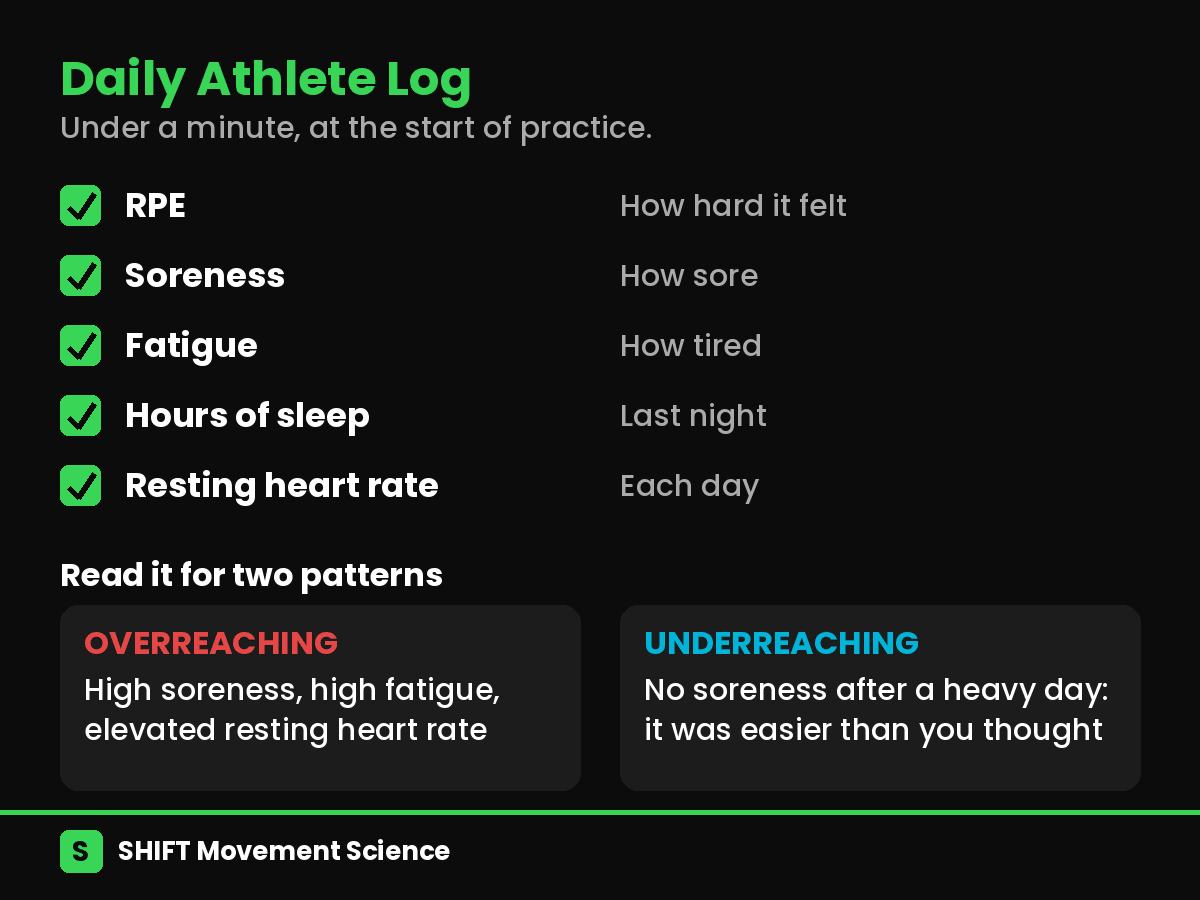
Two habits keep the log useful. First, keep it short. If it takes more than a minute, athletes will skip it or rush it, and the data gets worse. Second, look at it before you write the next day, not at the end of the month. A log that nobody reads is just homework. When an athlete sees you adjust practice because of what she wrote, she starts to take it seriously.
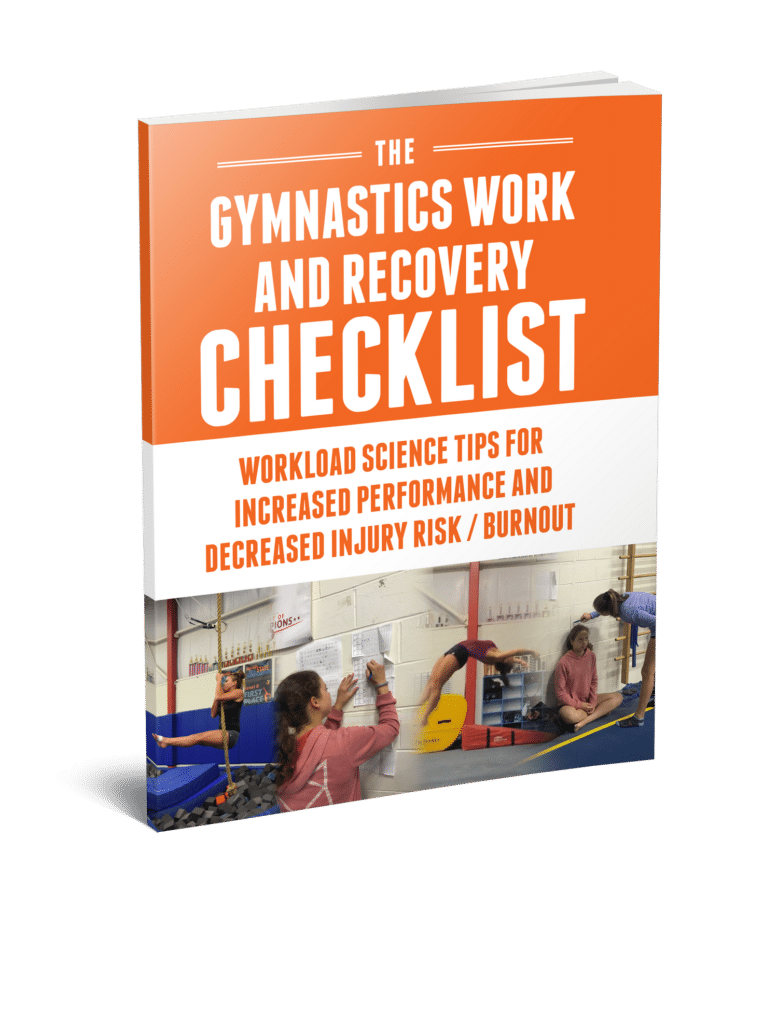
My free Gymnastics Work and Recovery Checklist in the free resource library gives you a place to start.
This week: have every athlete log in under a minute at the start of practice, and review the sheet before you write the next day.
Prepare the heads and the parents, because the meet is not just physical.
This point comes from clinical and coaching experience, not a study. Before the first meet, run a 20-minute meeting with parents and athletes. Cover expectations, how scoring works, what a fall means and what it does not, and the plan for the car ride home. My parent guide on the car ride home and fueling windows is worth sending ahead.

Each agenda item solves a problem I see at first meets. Parents who do not understand scoring read a low number as a verdict on their child. Athletes who think a fall is a disaster carry it into the next event. A short, clear explanation of how scoring works and what a fall means takes the pressure off everyone. The car ride home matters because it is where many families unload their own nerves on an athlete who is already tired and flat.
Agree on the warm-up and corral script as a coaching staff before meet day, so every athlete hears the same words from every coach. Then give each athlete one pre-routine cue and practice it in training, so it is automatic when the arena is loud and the legs are shaky.
A good cue is short and about what to do, not what to avoid. “Tall and tight” or “breathe, then go” works. “Don’t fall” does not, because it puts the fall in her head. Let the athlete choose or help shape it, since a cue she owns is a cue she will use.
This week: pick one cue per athlete and have them say it before every full routine in practice.
Common questions from coaches
What if my meet is closer than four weeks? Use the same order. Lock what you have, change one dial at most, and protect the lighter week in front of the meet, even if it means a shorter build.
What if an athlete is still missing a skill at the four-week mark? She competes the routine she can hit. A skill she cannot hit in practice is not ready for the arena, and the next meet is a fine place for it.
Will parents push back on a lighter week? Some will, because it can look like less training. Tell them why in the 20-minute meeting: athletes adapt in recovery, and the lighter week is how they arrive fresh and sharp.
Put this into practice
Monday, lock the routines and start the hit-rate tally. Tuesday, compare this week’s planned load to your four-week average and move only one dial. Wednesday, put the lighter week on the calendar and set the sleep, fueling and soft tissue standards. Thursday, start the daily log. Friday, schedule the 20-minute parent and athlete meeting. It’s just gymnastics, and the coaches who plan these four weeks usually have the quiet meets.
Want the actual programs, not just the framework? This is what I go deepest on inside The Hero Lab: the in-season planning lecture, plus the meet-prep and taper lectures that walk through the lighter week step by step. Use code HEROINSIDER for 25% off your first month.
— Dave
Dr. Dave Tilley, DPT, SCS, CSCS
References & Further Reading
- Soligard T, et al. How much is too much? (Part 1) International Olympic Committee consensus statement on load in sport and risk of injury. Br J Sports Med 2016.
- Schwellnus M, et al. How much is too much? (Part 2) International Olympic Committee consensus statement on load in sport and risk of illness. Br J Sports Med 2016.
- Gabbett TJ. The training-injury prevention paradox: should athletes be training smarter and harder? Br J Sports Med 2016.
- Caine DJ, Russell K, Lim L (eds). Handbook of Sports Medicine and Science: Gymnastics. Wiley-Blackwell 2013.
- Sands WA. Recovery. In: Jeffreys I, Moody J (eds). Strength and Conditioning for Sports Performance. Routledge 2016.