

Wrist and elbow pain in November is rarely just soreness. Most coaches read it as the price of pre-season, and by the time it stops being ignorable, a six-week problem has become an eighteen-week one. You are a month or more into pre-season or standing at your first meets, volume is climbing, and the joints that were never built to bear weight are absorbing all of it. Here’s the thing most coaches miss: the first 72 hours decide which timeline you get.
I am not asking you to diagnose anything. I am asking you to notice early, respond consistently, and hand the athlete to a medical provider at the right time.
Table of Contents
Wrists and elbows get hurt because gymnastics asks them to do a job they were not built for.
Wrists and elbows are not built for weight bearing, yet we load them with very, very high forces on every vault, tumbling pass and handstand. Add pre-pubertal athletes with open growth plates and huge flexibility and strength demands, and the risk stacks up. Injuries fall into two buckets: overuse, which is by far the most common, and accident or trauma, which is less common. The pattern behind overuse is consistent: sudden spikes in impact during warm-ups, conditioning and full routines, poor work-to-rest ratios, and not enough arm and upper-back strength to deload the joints. In the gym I see the spike far more often than the fall.
Picture a typical week. Your team spent September on basics and light conditioning. Then the first meet gets close, so Monday brings full routines, Tuesday adds extra vault reps, and Wednesday is a long tumbling session on top of handstand drills. Nobody fell. But the wrists went from a gentle load to a heavy one in about three days, and a gymnast starts rubbing her wrist between turns.
A common coaching mistake is to hunt for the one bad skill that caused it. Usually the cause is the week as a whole, so the fix lives in the plan.
This week: pull your last two weeks of practice plans and circle every day that hard tumbling, vault or handstand volume jumped. Those days are where your next injury starts.
Know the injuries by name, because each one looks different on the floor.
Gymnast wrist is stress to the growth plate at the end of the radius. It gets worse in growth spurts and can become a fracture quickly. Most weight-bearing force goes through the outside (radial) side of the wrist, which is why back-of-wrist pain is so common. Stiff forearms from gripping limit wrist extension and load the joint even more. Also watch for TFCC irritation, and for forearm splints in the men.
At the elbow, hyperextension overload means you teach soft elbows. Golfer’s and tennis elbow are, 9 times out of 10, a workload spike or under-capacity. OCD starts as outside-elbow pain with weight bearing, then moves to clicking, catching and locking, across four grades. It is the injury I co-authored a 2026 paper on, because catching it early changes everything. UCL sprains come from a fall on an outstretched arm.
Why do coaches need names? Because names tell you what to watch for.
You do not need to decide which injury it is. You need to describe what you see: where it hurts, which skills bring it on, and whether it is changing. A coach who can say “outside elbow, hurts in handstand, now clicking” gives a clinician far more than “her arm hurts.”
This week: cue soft elbows in every handstand and tumbling warm-up.
Use the Rule of 3 and give yourself 72 hours, not a guess.
“It’s just growing pains” became five months off with a heel stress fracture. “It’s just a hip flexor strain” was a labral tear. So stop or refer when pain is over 3/10, has limited three practices, is the third time the gymnast complains, or sits within three inches of a joint. I wrote the rule of 3’s for parents so families hold the same standard.
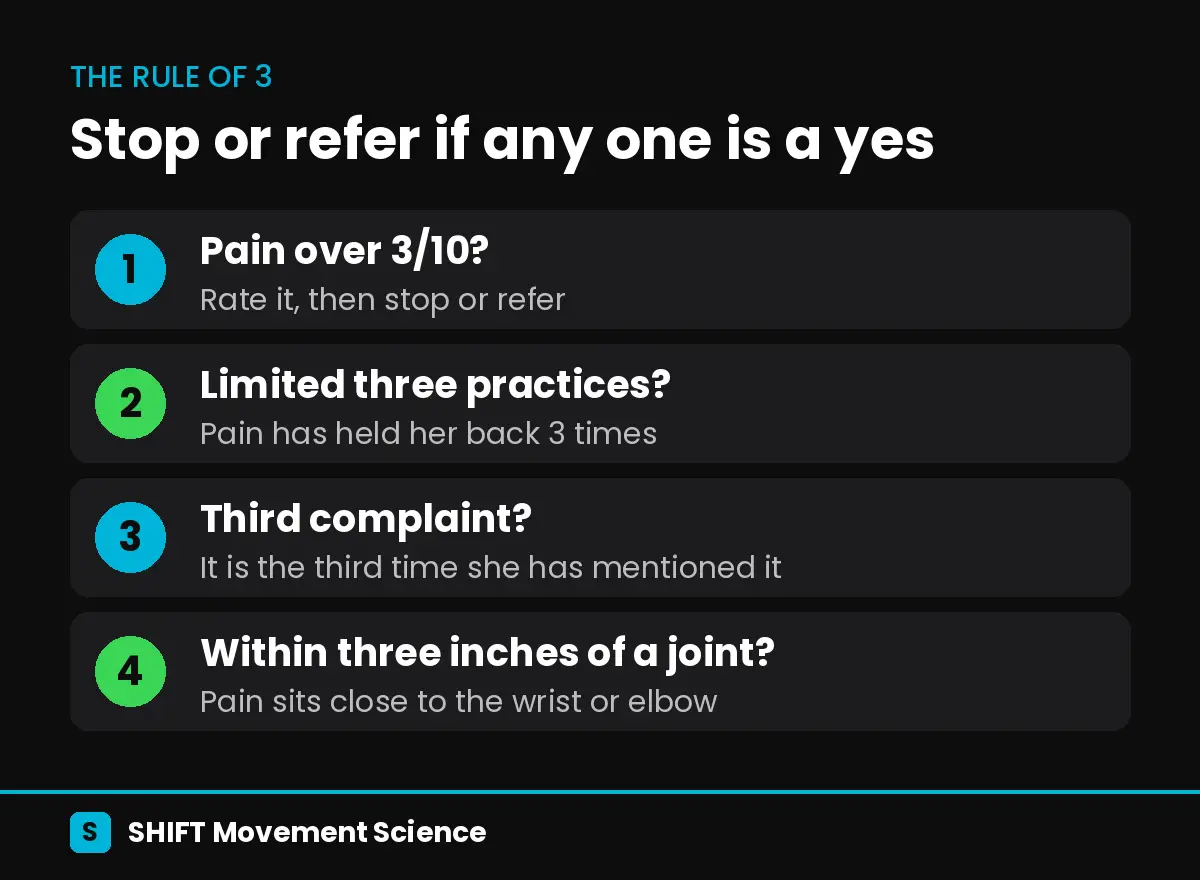
Notice that these are four separate questions, and any one of them is enough. A gymnast with pain at 2/10 who has now mentioned it for the third time still meets the standard. “Wait and see” feels reasonable every day until it has cost you months.
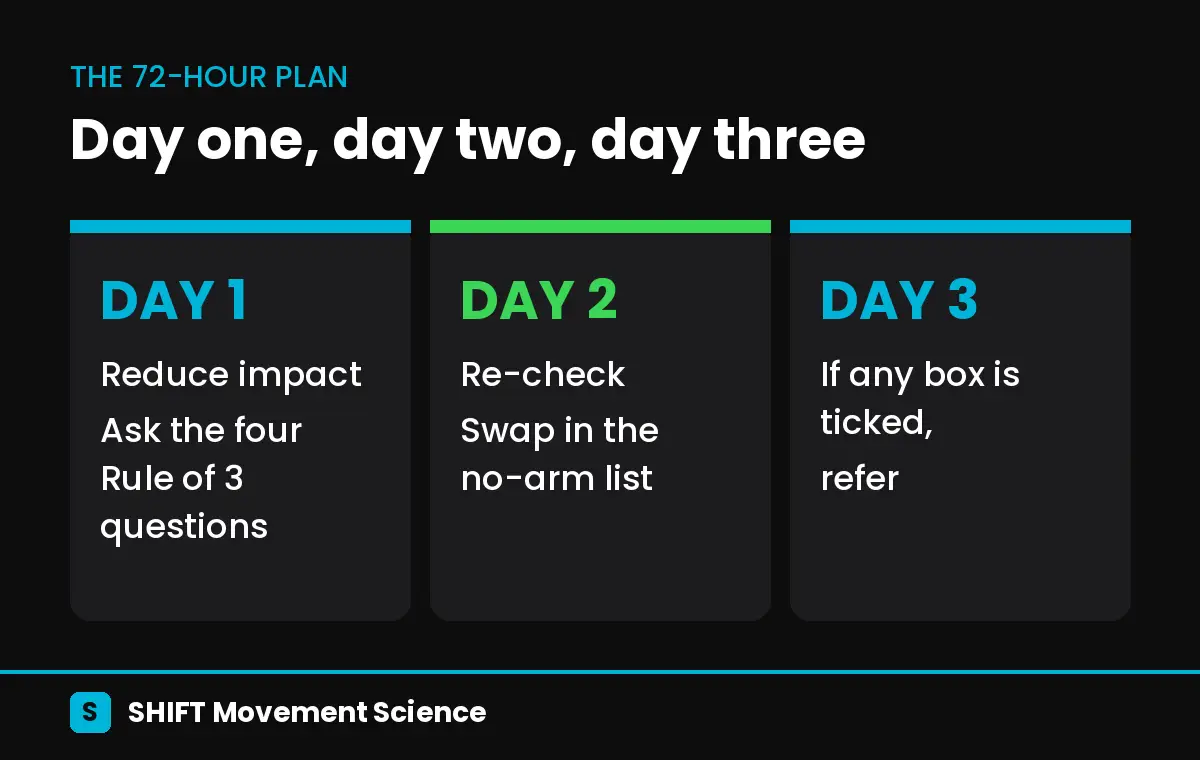
Day one: reduce impact and ask those four questions. Day two: re-check and swap in the no-arm list from point 4. Day three: if any box is ticked, refer.
Here is how that looks at practice. On Tuesday a gymnast tells you her wrist hurts on handstands. You cut the impact for her, put her on other work, and ask the four questions out loud: how bad is it out of 10, has it limited her in practice, is this the third time she has mentioned it, and is it right next to the joint? Write the answers down. On Wednesday you ask again and run the no-arm list. On Thursday, if a box is ticked, she goes to a medical provider.
The mistake I see most is the quiet one. The coach asks the questions on day one, gets a vague answer, and never asks again. The 72 hours only works if you actually come back to it on day two and day three.
Run it through my five principles: stay in your lane, focus on what can be done, embrace reality, work with a team, and use the Priority Filter of health, human, gymnast. Meet schedules do not make the list.
What do you say to the athlete and her parent? Keep it short and calm. Something like: “She told us her wrist is bothering her. We are following a simple rule we use for every gymnast. We are lowering the impact for a few days and checking back in, and if it ticks any of our boxes, we would like a medical provider to look at it.” That tells the family you took it seriously, you have a plan, and you are not guessing. It also avoids a diagnosis you are not qualified to give.
This week: tape the four Rule of 3 questions to your clipboard.
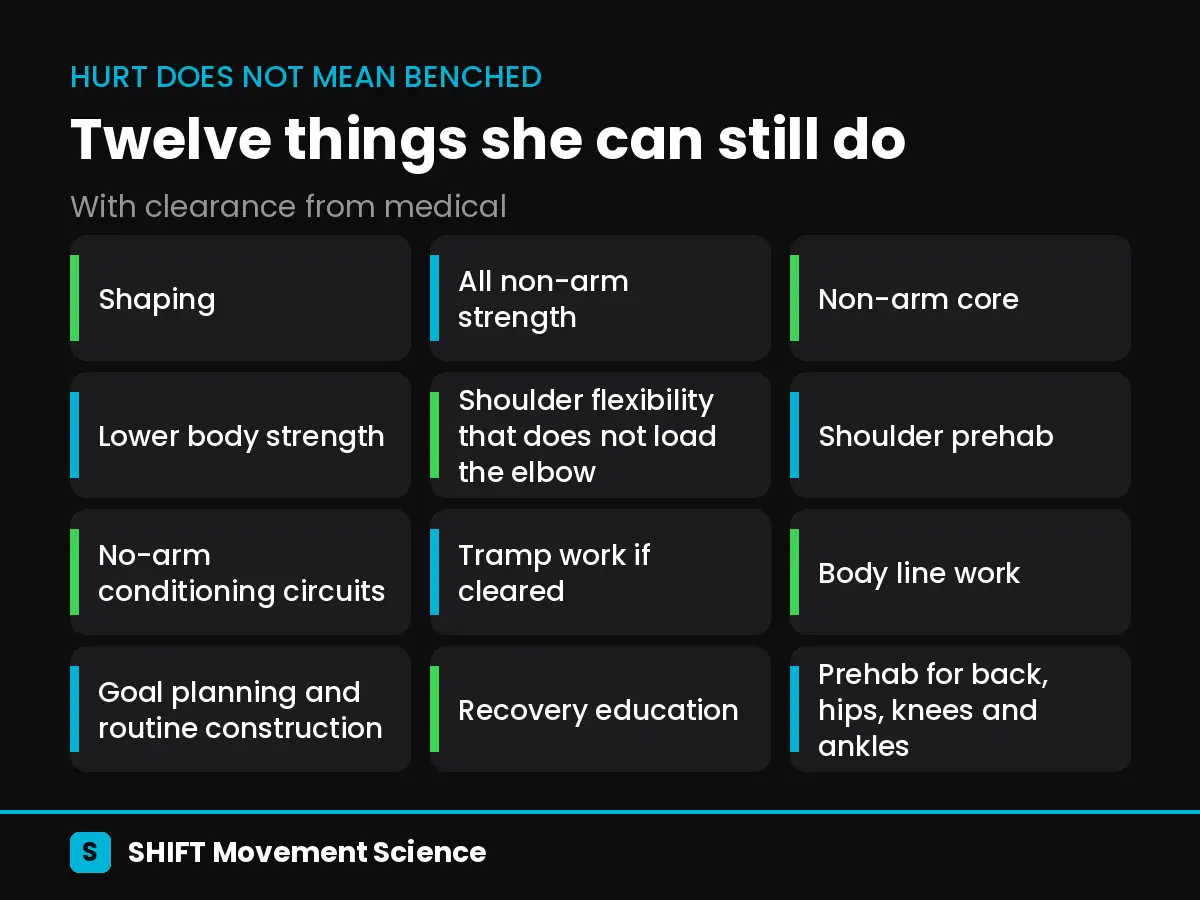
Hurt does not mean benched: twelve things she can still do with medical clearance.
Focus on what can be done. With clearance from medical, the list is long: shaping, all non-arm strength, non-arm core, lower body strength, shoulder flexibility that does not load the elbow, shoulder prehab, no-arm conditioning circuits, tramp work if cleared, body line work, goal planning and routine construction, recovery education, and prehab for back, hips, knees and ankles.
An injured gymnast sent to the bench often feels removed from the team. One with a full plan of her own stays part of practice: still training, still improving, still in the room. That makes her more willing to tell you the next time something hurts.
Then be honest about the clock. Gymnast wrist runs 6 weeks if mild and caught early, 12 if moderate, 18 or more if severe. OCD runs 2 to 6 weeks before grade 1, 12 or more at moderate grade, and 9 months to a year with surgery. Most fractures take about 4 months or more in total.
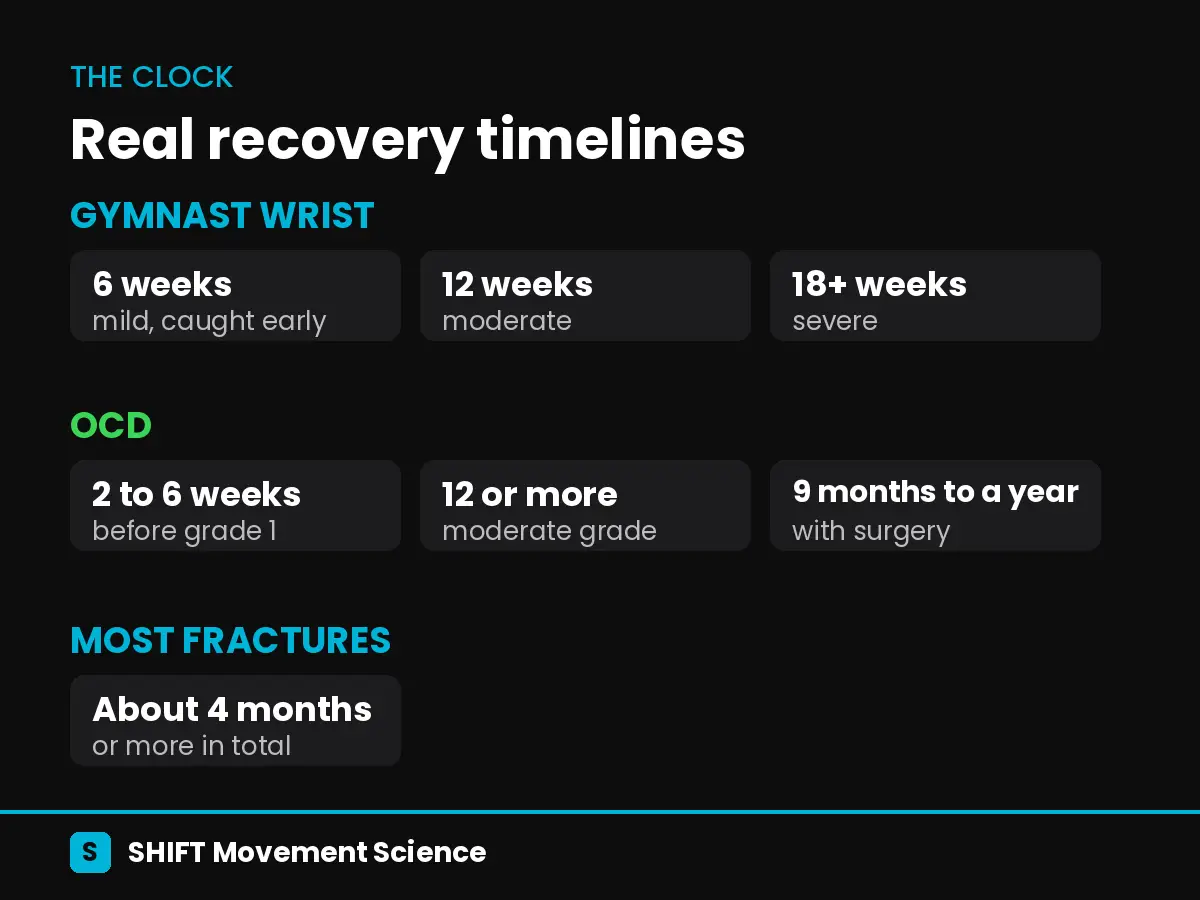
When a parent asks “how long will this take?”, your honest answer is that it depends on what the medical provider finds, and that catching it early gives the best odds. These ranges help you set expectations, but they do not replace an assessment.
This week: write the no-arm list on one card, so day two takes five minutes.
Prevention is a slow build, and a flare-up is a plan, not a panic.
Build weight-bearing and hard-tumbling volume slowly, schedule deloads, and give soft tissue care a regular slot. Train the shoulders and upper back to unload the joints: face pulls, renegade rows, overhead carries and Turkish get-ups. My free Gymnastics Pre-Hab Guide is a good place to start.
For a flare-up, reduce impact first with Tumbl Trak, the pit, 8-inch mats and rolling out of dismounts. Consult medical. Ice nightly, which helps pain. Build arm strength while impact is deloaded. Then rebuild impact volume over 2 to 4 weeks, even in meet season. My rule of thumb: plan 2 to 3 times as much ramp-up as time off.
The coaching mistake on this side is the rush back. She feels better after a short break, the meet is close, and she goes straight to full volume. That is how the spike comes back.
This week: pick one upper-back exercise and add it to every practice.
Common coach questions
Do I have to wait for the Rule of 3 before I act? No. The rule is a minimum standard for stopping or referring, not a reason to ignore pain until it is reached. Day one starts the first time a gymnast mentions wrist or elbow pain: reduce impact and ask the four questions.
What if she says it feels better today? Re-check anyway. Day two is built for this. Feeling better on one day does not erase a pattern, and the questions about practices limited and complaints made still count.
What if the parent wants her to keep competing? Share the Rule of 3 with them. That is why I wrote the rule of 3’s for parents. When the whole family and the whole staff use the same standard, it stops being an argument and becomes the way your gym works.
Put this into practice
Monday, audit your last two weeks for volume spikes and pick one to smooth out. Tape the Rule of 3 to your clipboard and start the 72-hour clock the first time a gymnast mentions wrist or elbow pain. Write your no-arm list so day two is ready. Add one shoulder or upper-back exercise to every practice. By Friday, you will have a system instead of a guess.
Want the actual programs, not just the framework? This is what I go deepest on inside The Hero Lab: the Upper Extremity injury course content, and the wrist and elbow rehab and return-to-impact programs. Use code HEROINSIDER for 25% off your first month. And a heads up: the Black Friday bundles open November 24, and anyone who has bought from SHIFT before gets in early on November 20.
— Dave
Dr. Dave Tilley, DPT, SCS, CSCS
References & Further Reading
- Tilley D. Elbow and Wrist Injuries in Gymnastics: A Coaches Guide. Lecture, SHIFT Movement Science.
- DiFiori JP, et al. Wrist pain, distal radial physeal injury, and ulnar variance in the young gymnast. Am J Sports Med 2006.
- Webb BG, Rettig LA. Gymnastic wrist injuries. Curr Sports Med Rep 2008.
- Caine DJ, Russell K, Lim L (eds). Handbook of Sports Medicine and Science: Gymnastics. Wiley-Blackwell 2013.