Two gyms opened their doors on the same Monday in September.
Both had good coaches. Both had athletes who’d worked hard all summer. Both had a whiteboard with a season plan scrawled on it in dry-erase marker.
One gym walked into pre-season with a written checklist — five categories, five checkable items each, taped inside the coaches’ office where every staff member could see it and check boxes off in real time. The other gym walked in with good intentions. A general sense that culture mattered, that the ramp shouldn’t be too fast, that kids needed to sleep and eat and lift weights. Nothing written down. Nothing anyone could point to and say “did we actually do this.”
By November, the two gyms looked like they were training different sports. Not because one staff cared more than the other — I’ve never met a gymnastics coach who didn’t care. The difference was that one gym had turned its intentions into a system, and the other was still relying on memory, mood, and whoever happened to be in the room that day.
A written checklist doesn’t replace good coaching. It replaces good intentions with something you can actually check.
That’s the whole idea behind the tool I want to walk you through this week: The 25-Box Pre-Season Checklist — five pillars, five checkable actions each, one page, five minutes to score. It’s not a philosophy. It’s an operating system for the six to eight weeks that decide whether your season starts strong or starts digging out of a hole.
PS if you want the PDF right in your inbox to see now, just click below!
FREE Gymnastics
Pre Season Checklist
Gymnastics season is coming quickly! Get my "must-have" tips to set up your best competition year yet.
This post is your guided tour. Over the next two weeks we’ll go deep into two of the five pillars — Culture, then Strength & Conditioning — with full protocols you can run tomorrow. Today, I want you to see the whole map before we zoom into any one country on it.
Table of Contents
Why a checklist, and why now
Pre-season is the highest-leverage window of the entire year. It’s the six to eight weeks where your culture either calcifies into something healthy or calcifies into something you’ll spend February trying to undo. It’s the stretch where load either climbs at a rate a body can absorb or spikes past what tissue is prepared for. It’s when strength, conditioning, and recovery habits get set for the next nine months — good or bad.
The problem isn’t that coaches don’t know these things matter. It’s that “things that matter” and “things that get checked off a list every single week” are not the same category. Under the pressure of a normal gym day — parents at the desk, an athlete in tears on beam, a rotation running eight minutes behind — the stuff that isn’t written down is the stuff that quietly slides.
A checklist doesn’t ask you to know more. It asks you to look at the same five boxes at the same time every week until checking them becomes as automatic as taking attendance.
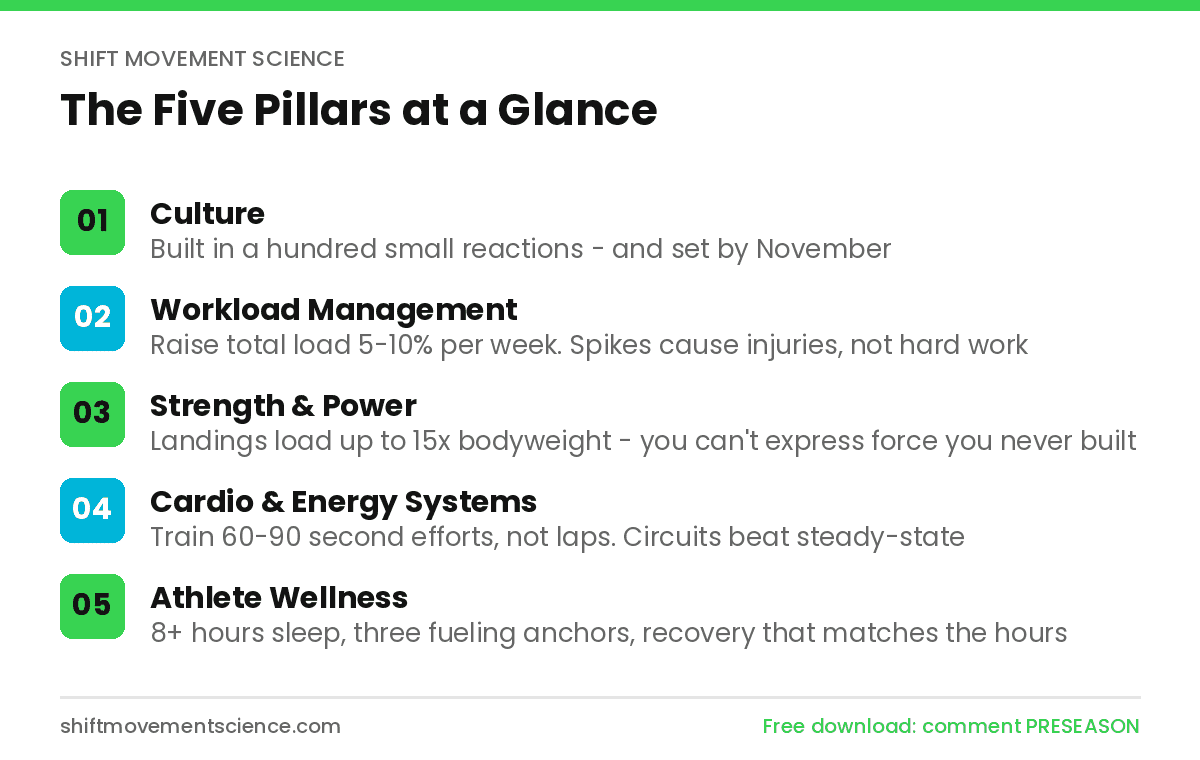
The five pillars, and a sample of what’s inside each
The full checklist has 25 boxes. Here’s a preview — two or three sample items from each pillar, enough to show you how it thinks. We’ll unpack Culture and Strength & Conditioning box-by-box in the next two posts.
Pillar 1: Culture
Culture sits at the bottom of the stack. Everything else — strength, conditioning, skill acquisition — gets built on top of it, which means a shaky culture eventually cracks all three.
- ☐ Ran a scored, 5-category staff culture audit in week one (Communication, Safety & Injury Response, Effort vs. Fear, Athlete Voice, Parent Relationships)
- ☐ Picked ONE lowest-scoring category and built a one-month plan to fix it specifically
- ☐ Set 5–7 explicit team guidelines the whole group has heard and agreed to out loud
Culture isn’t set in a staff meeting. It’s set in a hundred small reactions in the first few weeks of pre-season — and by November, most of them have calcified into “just how we do things here.”
Pillar 2: Workload Management
This is the pillar most injuries actually live in, and it’s the one coaches most often manage by feel instead of by number.
- ☐ Increased total training load (hours AND intensity) by roughly 5–10% per week, not all at once. These means counting, tracking, and slowly scaling up the repetitions of skills, half sets, routines, and hard landings.
- ☐ Budgeted 5–6 weeks to go from summer/off-season hours to full pre-season load
- ☐ Confirmed skills at 3-5 reps before rebuilding drill and half-routine volume — skill retention and tissue capacity don’t return on the same timeline
Injury risk doesn’t track with how much an athlete trains overall. It tracks with how sharply this week’s load jumps above what the body has actually been prepared for. A gym can hold total hours flat while quietly doubling difficulty, and that’s still a spike — which is exactly why “we didn’t add more hours” isn’t the same as “we didn’t add more load.”
Pillar 3: Strength & Power
The off-season is the only real window to build strength. Pre-season’s job is to maintain it while shifting emphasis toward gymnastics-specific power output and short-burst cardio capacity (anaerobic output, aimed at 60-90s floor routine).
- ☐ Programming covers every basic movement pattern — squat, hinge, single-leg, push, pull, 3D core — alongside gymnastics-specific handstand and shaping work
- ☐ Running the Daily Dozen (or an equivalent basics circuit) 30 minutes, 4x/week
- ☐ Tracking 2–3 simple numbers per athlete (hollow hold time, handstand hold, strict chin ups, etc) and re-checking every two weeks
Landings and blocks in gymnastics can put forces on the body up to 15 times bodyweight. Bodyweight training alone doesn’t build tissue capacity for that. That single fact is worth sitting with before anyone on staff argues a gymnast doesn’t need to lift.
Pillar 4: Cardio & Energy Systems
Long, slow running builds an engine gymnastics doesn’t use, while stacking ground-impact stress the sport doesn’t need more of. Conditioning needs to look like the sport.
- ☐ Running circuits, not steady-state cardio — 8–12 stations, 2 rounds, 15–20 minutes, 2x/week
- ☐ Progressing the work:rest interval on a real timeline: 40 sec on/20 off → 45/15 → 50/10
- ☐ Following the 8+4 model — roughly 8 weeks of aerobic base before shifting toward 60–90 second burst efforts that match an actual routine
You don’t build repeat-effort capacity by skipping straight to repeat efforts. You build it by building the recovery system underneath them first.
Pillar 5: Athlete Wellness
Training hours climb every single week of pre-season. Fuel and sleep usually don’t. That gap is where injuries and plateaus quietly start.
- ☐ Three fueling anchors are in place: carbs 2–3 hours before practice, a real snack for any session past ~90 minutes, protein + carb within 1–2 hours after
- ☐ Sleep is treated as a coached, trainable skill — target 8+ hours, consistent sleep/wake time, even on weekends
- ☐ Staff can name RED-S (Relative Energy Deficiency in Sport) as a real, documented risk — without diagnosing anyone, and knows when to refer out to a dietitian or physician
A body cannot adapt to a training load it was never given the resources to recover from. Most of what reads as a motivation problem in October is actually an under-recovered athlete in September.
How to score it
Here’s the part that turns the checklist from a nice idea into a diagnostic. Each of the 25 boxes is either checked or it isn’t — no partial credit, no “we kind of do that.” Tally your checks across all five pillars and read the band:
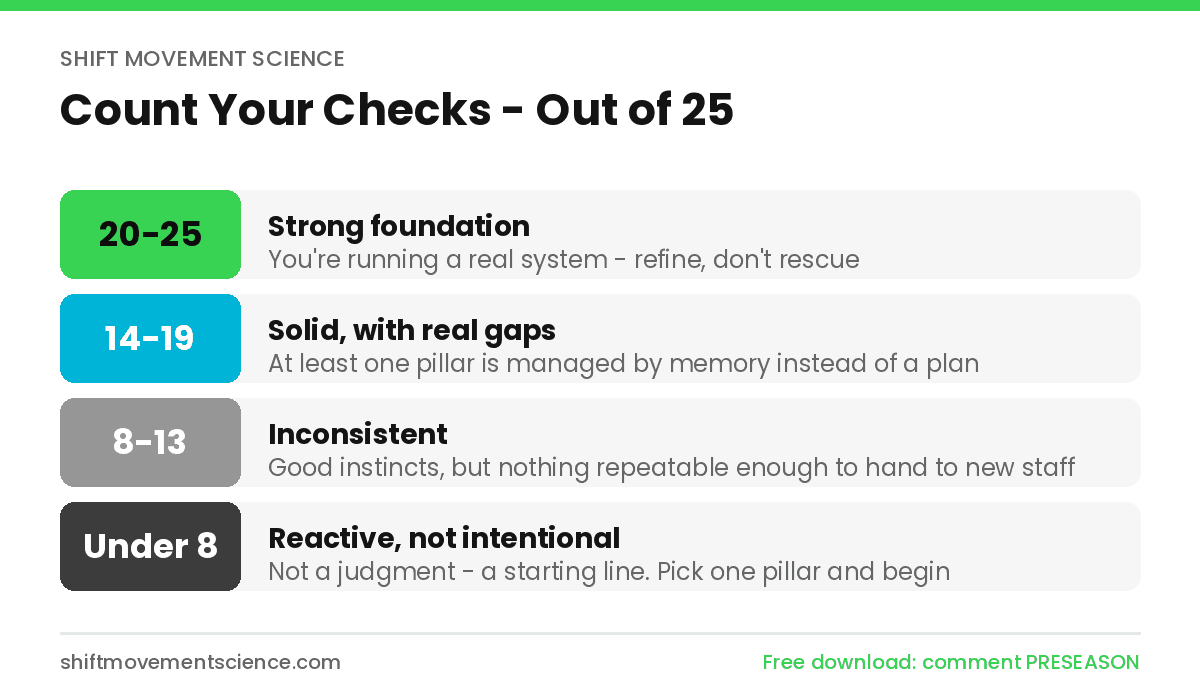
- 20–25 checked — Strong foundation. You’re running a real system; the work now is refinement, not rescue.
- 14–19 checked — Solid, with real gaps. You have structure in most pillars but at least one is being managed by memory instead of a plan.
- 8–13 checked — Inconsistent. Good instincts scattered across the gym, but nothing repeatable enough that a new staff member could pick it up cold.
- Under 8 checked — Reactive, not intentional. This isn’t a judgment — it’s a starting line. Every gym on this list started somewhere.
A low score isn’t an indictment. It’s a map. It tells you exactly which pillar to work on first instead of trying to fix five things halfheartedly, which is really just fixing nothing at all.
What to do with your score this week
Don’t try to check all 25 boxes by Friday. Pick the pillar with your lowest score, and inside that pillar, pick the single lowest-scoring item. Build a one-month plan around fixing that one thing. That’s it. That’s the whole first move.
Over the next two posts we’re going to hand you the exact protocols for two of these pillars — the 60-minute staff meeting and audit walkthrough that resets Culture, and the whiteboard test, Daily Dozen, and conditioning progressions that make up the Strength & Conditioning engine. If those happen to be your lowest-scoring pillars, good. That’s not a coincidence — those two protocols are where most gyms find the fastest movement.
You don’t need a perfect gym. You need one honest look at 25 boxes and one deliberate fix.
Get the Full Checklist and Keep Building
1. Grab the free download. The 25-Box Pre-Season Checklist — every pillar, every box, ready to print and tape in your coaches’ office.
FREE Gymnastics
Pre Season Checklist
Gymnastics season is coming quickly! Get my "must-have" tips to set up your best competition year yet.
2. Take the free course. If pre-season structure is new territory for your staff, start with the free Essentials of Gymnastics Coaching course at shiftmovementscience.com/freecoaches/.
3. Go deeper in The Hero Lab. For the full programming behind every pillar on this checklist — templates, tracking sheets, and monthly coaching breakdowns — join The Hero Lab and use code HEROINSIDER for 25% off your first month.
References
- Gabbett, T. — acute:chronic workload ratio and the training-injury prevention paradox (British Journal of Sports Medicine)
- Mujika, I. & Padilla, S. — detraining research on strength/aerobic decay vs. skill retention
- Lloyd, R. & Oliver, J. (eds.) — Strength and Conditioning for Young Athletes: Science and Application
- Haff, G. & Triplett, N.T. (eds.) — NSCA’s Essentials of Strength Training and Conditioning
- Bompa, T. & Buzzichelli, C. — Periodization: Training for Sports
- Milewski, M. et al. — adolescent athlete sleep duration and injury risk
- Mountjoy, M. et al. — IOC consensus statement on Relative Energy Deficiency in Sport (RED-S)
- Boyle, M. — New Functional Training for Sports
- MacDougall, D. & Sale, D. — The Physiology of Training for High Performance