

Every athlete walking into your gym is internally running two equations at once, whether anyone’s written them down or not.
One is the Work Equation — the training side. Basics, shaping, strength, cardio, and the ramp that connects August to a full pre-season load. That’s the side coaches build, program, and take credit for. It’s visible. It’s on the whiteboard.
The other is the Rest Equation — the recovery side. Time between sessions, sleep, fueling, hydration, stress, and the everyday logistics of being a kid with school and a life outside the gym. That side is quieter. Nobody puts it on a whiteboard, but it’s just as much a program as the training is, and it needs just as much intention.
Pre-season success isn’t about maximizing one side. It’s about balancing both — because a body doesn’t adapt to training alone. It adapts to training and recovery, together, and if one side of that equation is neglected, the other side’s work doesn’t hold.

FREE Gymnastics
Pre Season Checklist
Gymnastics season is coming quickly! Get my "must-have" tips to set up your best competition year yet.
Table of Contents
The Work Equation
This is the side most gyms already do reasonably well, because it’s the side everyone’s trained to think about. It has five parts.
Good basics. Hollow holds, arch holds, handstand work, shaping drills— the unglamorous foundational work that doesn’t look like progress on the day you do it but is the floor everything else stands on. Skip it in pre-season and you’re building skills on top of a foundation that was never poured.
Shaping. The body tension and the positions that show up in every skill on every event. This is where a lot of skill-level ceilings actually live — not in strength or courage, but in an athlete never having owned the shape a skill requires.
Strength. Programmed resistance and body weight training across the basic movement patterns — squat, hinge, push, pull, single-leg, and rotational core — ramping from higher-volume, lower-intensity work early in the off-season toward lower-volume, higher-intensity work as pre-season closes in on full routines.
Cardio. Not laps. Circuits and intervals built around the actual time-under-tension of a routine, so the conditioning an athlete builds matches the conditioning the sport actually demands.
The ramp. All four of the pieces above only work if the load underneath them increases at a rate the body can absorb — 5-10% per week, not more, even in the weeks where everyone feels ready to push harder. We went deep on exactly how to build and audit that ramp in the workload blog earlier in this series, so I won’t re-run the whole argument here. The short version: a gym can hit every one of the first four boxes and still injure athletes in October if this fifth box — the rate of increase — gets ignored.
That’s the Work Equation. Most pre-season planning conversations start and end here, because it’s the half of the picture that’s easy to see, easy to measure, and satisfying to build. It’s also, on its own, incomplete.
The Rest Equation
Here’s the half that doesn’t get a whiteboard. It has just as many moving parts, and every one of them is coachable — it just requires treating recovery as a program, not an afterthought.
Enough time between sessions. Back-to-back hard days, doubled-up practices, or a competition prep block layered directly on top of a heavy strength week all draw from the same recovery bank account. The body doesn’t just need less training — it needs adequate windows between hard efforts to actually absorb what those efforts asked of it.
As much sleep as possible. The target is 8-plus hours a night, and that number isn’t arbitrary. Milewski and colleagues’ research on adolescent athletes found that those sleeping under roughly eight hours a night showed meaningfully higher odds of injury than their well-rested peers. That’s a direct, physiological reason pre-season sleep deserves the same planning rigor as the training hours do — not a wellness slogan, a risk number.
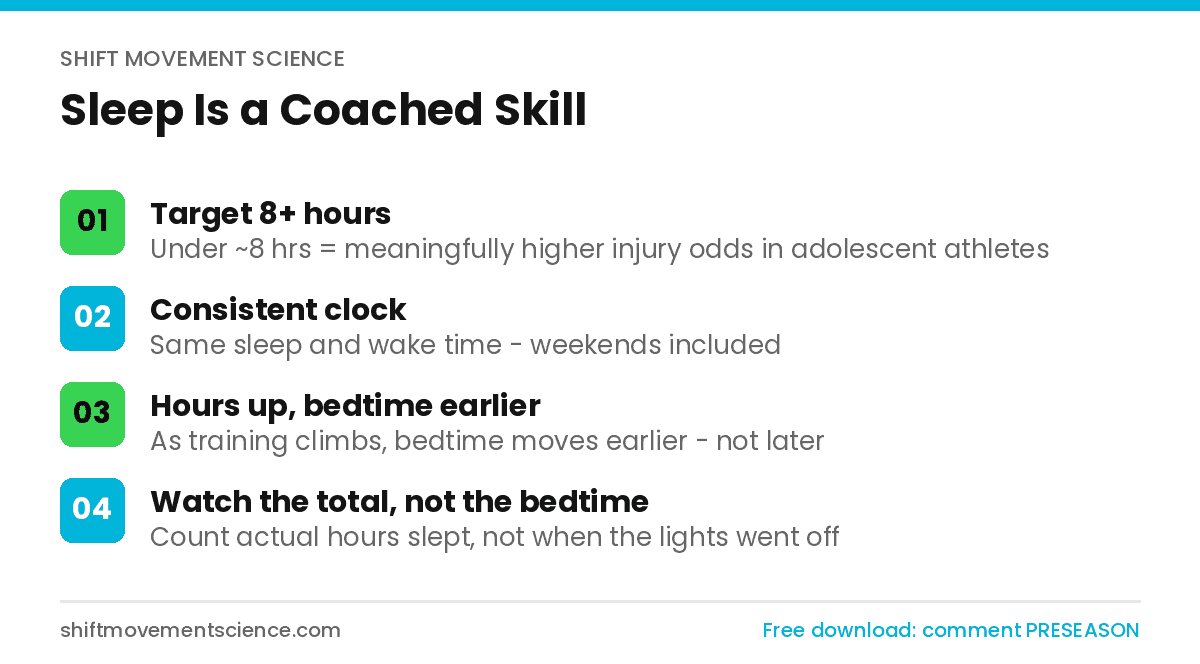
Sleep isn’t a fixed trait some kids “just have.” It’s trainable: a consistent sleep and wake time including weekends, morning light to anchor the body’s clock, dimmer screens in the hour before bed, and a cool, dark room. As training hours climb through pre-season, bedtime needs to move earlier, not later — which is the opposite of what usually happens by default, because bedtime is the only part of the evening without a hard external deadline.
Educating athletes on the rest of the picture. This is the part of the Rest Equation that’s easiest to skip, because it doesn’t happen in the gym — it happens at home, at school, and in the car on the way between the two. Three things matter most:
- Managing stress levels. Pre-season stacks training stress on top of whatever school, friend group, and family stress an athlete is already carrying. Nobody’s asking coaches to become therapists, but naming stress as a real variable — and knowing when a kid needs more than a pep talk — matters.
- Keeping the schedule on beat. When practice runs long and homework gets pushed later, sleep is what quietly gives up the difference. An athlete whose school schedule is buried by an unpredictable practice schedule is fighting a Rest Equation that was never given a fair chance.
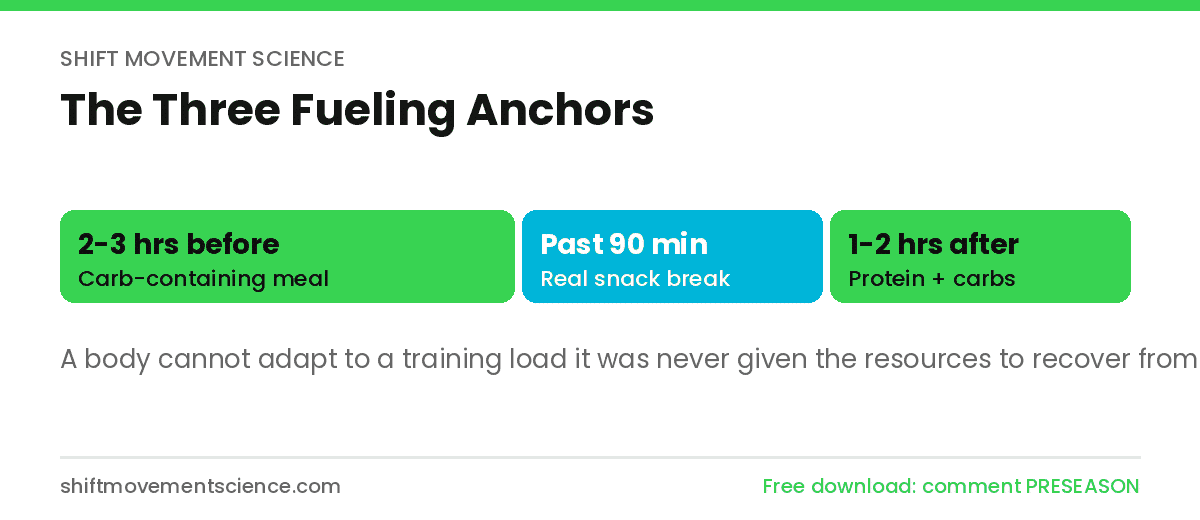
- Fueling, hydration, and general self-care. This is where the ramped-up nutrition education belongs: a carbohydrate-containing meal or snack 2-3 hours before practice, a real structural snack break for any session running past 90 minutes, and a combination of protein and carbohydrate 1-2 hours after training, while the body is primed to actually use it. Add consistent hydration and the basic self-care habits — not skipping meals, not chasing a “leaner” look, not treating soreness as something to push through silently.
That fueling education matters for a reason bigger than performance. Relative Energy Deficiency in Sport (RED-S) — chronic under-fueling relative to training demand — is a real, documented phenomenon that the International Olympic Committee’s consensus statement ties to consequences ranging from impaired bone health and menstrual dysfunction to immune suppression, mood disturbance, and blunted long-term development. I’m not asking coaches or parents to diagnose RED-S off a checklist. I’m asking everyone around an athlete to know it exists, to protect the fueling anchors above as non-negotiable, and to refer to a sports dietitian or physician — not handle it in-house — the moment something looks off.
A body doesn’t adapt to a training load. It adapts to a training load it was given the resources to recover from.
Two equations, two composite athletes
I’ve seen both sides of this go wrong more times than I can count. Neither one is about a bad kid or a bad coach — it’s about one side of the equation quietly going unbalanced while the other side keeps climbing on schedule.
The athlete side. Picture an athlete I’ve seen versions of many times: sleeping four to five hours a night through the heart of pre-season — not because of any one dramatic thing, but because of a phone that stayed on past midnight, a school schedule that ran late, and a household routine that hadn’t been built around what training now required.
The training plan itself was well-designed. It didn’t matter. No program, no matter how well the coach ramps the load, survives an athlete running on a third less sleep than the body needs to absorb it. That side of the equation belongs to the athlete and the family — not because anyone did anything wrong on purpose, but because it’s the side coaches genuinely can’t control from the gym floor. The most a coaching staff can do is educate clearly, flag the pattern early, and loop in parents as partners rather than staying quiet and hoping it resolves itself.
The coaching side. I’ve also watched well-meaning coaching staffs run routine-prep blocks with real intensity — back-to-back hard days, minimal recovery time between heavy sessions, expectations that assumed every athlete could absorb the same load at the same rate. Nothing about any single session looked unreasonable in isolation.
But strung together over two or three weeks with too little recovery time between them, athletes who looked fine in week one were flat, short-tempered, and breaking down in week three. That’s not a discipline problem or a mental toughness problem. That’s the Work Equation running without a matching Rest Equation underneath it, and it’s squarely on the side of the staff to build recovery time into the schedule with the same intention as the hard days.
Neither story is about blame. The equation just has to balance. Every gym has some version of both risks running at once — an athlete or two whose home routine hasn’t caught up to their training load, and a schedule that occasionally asks more than it gives back. The fix isn’t finding who’s at fault. It’s checking both sides, regularly, and treating an imbalance on either side as information, not an accusation.
Balancing the two equations this week
You don’t need a new system to start closing this gap — you need to look at both sides of the ledger with the same seriousness.
- Audit your Work Equation. Are basics, shaping, strength, and cardio all getting programmed time, and is the ramp holding at 5-10% per week? (Full audit tools live in the workload blog earlier in this series.)
- Audit your Rest Equation just as deliberately. Post the three fueling anchors where athletes and parents both see them. Ask two or three athletes, privately, what time they actually fell asleep last night — not what time they went to bed.
- Build recovery time into the schedule on purpose, especially around hard routine-prep blocks, instead of assuming athletes will absorb back-to-back intensity without a cost.
- Talk to families as partners, not bystanders. The Rest Equation includes decisions made at home. A five-minute conversation about sleep and school scheduling does more for pre-season readiness than almost anything that happens on the floor.
- Know the referral pathway for RED-S concerns before you need it — a sports dietitian or physician, not a guess made in the gym.
Both equations are coachable. Neither one balances itself.
Get the full system
1. Free download — The 25-Box Pre-Season Checklist. This Work/Rest balance is one box out of 25 that cover every pillar of a safe, well-built pre-season. Drop your email below and ill send you the entire PDF that I work with gyms and gymnasts on
FREE Gymnastics
Pre Season Checklist
Gymnastics season is coming quickly! Get my "must-have" tips to set up your best competition year yet.
2. Free course. If you want the deeper “why” behind every one of these systems — culture, workload, strength, conditioning, and wellness — take the free course at shiftmovementscience.com/freecoaches/.
3. The Hero Lab. For coaches who want ongoing programming, athlete-wellness tracking tools, and direct access to me and the SHIFT team, join The Hero Lab. Use code HEROINSIDER for 25% off your first month.
FREE Gymnastics
Pre Season Checklist
Gymnastics season is coming quickly! Get my "must-have" tips to set up your best competition year yet.
References
- Milewski, M. et al. — Adolescent athlete sleep duration and injury risk.
- Mountjoy, M. et al. — IOC Consensus Statement on Relative Energy Deficiency in Sport (RED-S).
- Gabbett, T. — acute:chronic workload ratio and the training-injury prevention paradox (British Journal of Sports Medicine).
- Haff, G. & Triplett, N.T. (eds.) — NSCA’s Essentials of Strength Training and Conditioning.