The 60 Minute Pre Season Meeting EVERY Gym Needs To Have

The gym was quiet for once — kids gone, parents gone, just five coaches sitting on folding chairs in a circle instead of behind the front desk. It was the first Monday of pre-season, and the head coach had done something the staff had never done together before: closed the gym an hour early and put one hour on the calendar with a single agenda item. Not choreography. Not the meet schedule.
Culture.
Nobody was quite sure what to expect. One coach assumed it would be a pep talk. Another assumed it would turn into a complaint session about a specific athlete. What actually happened was quieter and more useful than either: five coaches, five sheets of paper, and twenty-five honest scores that nobody had ever asked each other to give out loud before.
That hour didn’t fix the gym’s culture in sixty minutes. But it did something almost as important — it made the culture visible for the first time. And you cannot fix in February what you never even looked at in September.
This is the story of that meeting, told as a protocol you can run in your own gym this week. It’s Pillar 1 of the 25-Box Pre-Season Checklist, and it carries more weight than any other single item on the list, because everything else — strength, conditioning, load management, wellness — gets built on top of whatever culture is already sitting underneath it.
Culture is the 800-pound gorilla in the room. Ignore it and it doesn’t leave. It just gets heavier.
Before we get started – if you want that exact Pre Season PDF Checklist for free grab it here. I designed it to be a tool for reflection and growth in a gym, but also an incredible conversation starter. If you nail this, you are well on your way to being happier and more successful at the gym.
FREE Gymnastics
Pre Season Checklist
Gymnastics season is coming quickly! Get my "must-have" tips to set up your best competition year yet.
Table of Contents
Why the first weeks matter more than any other
Here’s the uncomfortable truth about gym culture: it isn’t set in a staff meeting, a mission statement, or a poster on the wall. It’s set in a hundred small reactions during the first few weeks back — how a coach responds the first time an athlete says something hurts, whether a joke lands as fun or as fear, whether a hard conversation with a parent happens proactively or gets avoided until it explodes. By November, most of those small reactions have already calcified into “just how we do things here,” and changing “how we do things here” gets exponentially harder the longer it’s been normalized.
That’s why this protocol runs in week one, not week six. Pre-season is the single highest-leverage culture window of the entire year.
A healthy culture, to be clear, isn’t the absence of hard conversations or the absence of tears. Gymnastics is hard, and hard things produce real emotion. A healthy culture is one where an athlete feels safe telling the truth about pain, fear, or a mistake without expecting punishment or shame in return. That’s the target. Everything in this protocol is built to move a gym toward it.
Protocol 1: The Staff Culture Audit — Scored Out of 75
Before the staff meeting happens, every coach fills out the same audit privately, on their own, without comparing answers.
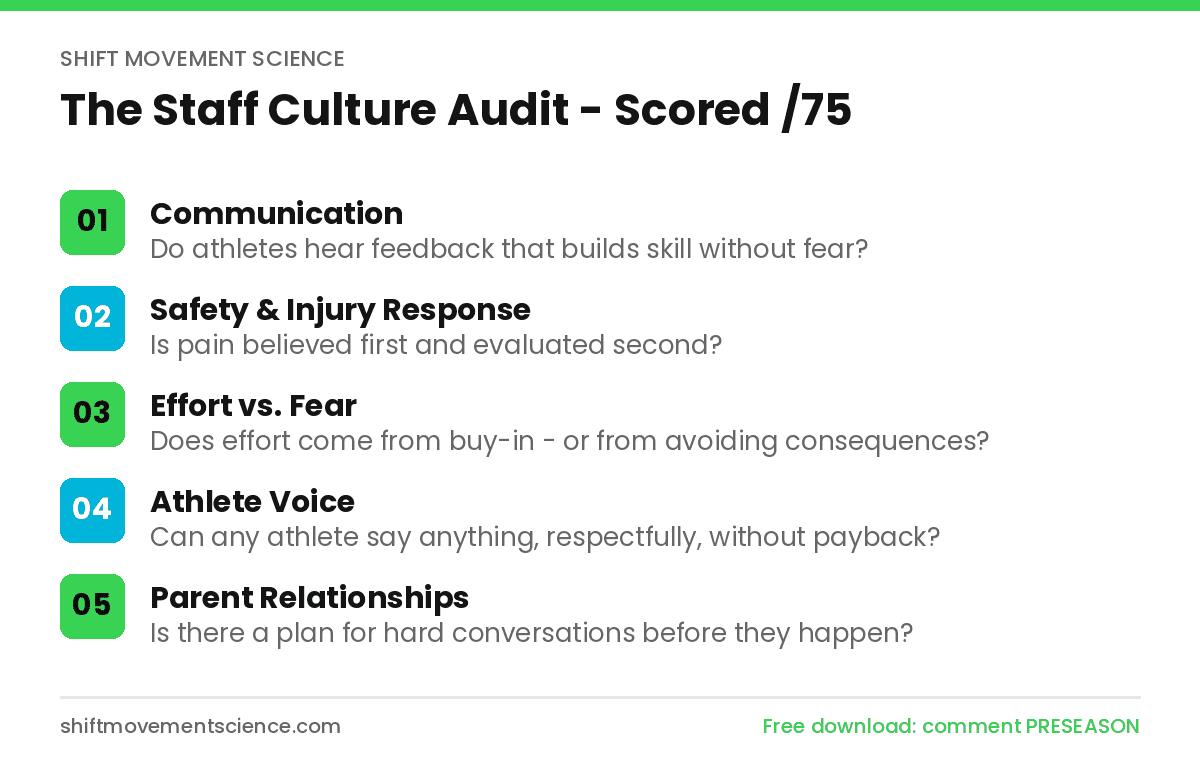
The structure: 5 categories, 5 items each, scored 1–3 per item (1 = rarely true, 2 = sometimes true, 3 = consistently true). Maximum score: 75.
- Communication — Do coaches explain the “why” behind drills? Do athletes know what to expect from a training block? Is feedback specific rather than just corrective?
- Safety & Injury Response — Are reports of pain believed first and evaluated second? Is there a clear, known process for what happens when someone reports an injury?
- Effort vs. Fear — Is hard work driven by challenge and ownership, or by fear of a coach’s reaction? Would athletes describe practice as demanding or as scary?
- Athlete Voice — Do athletes have any real input into their own training? Do they believe a concern raised to a coach will actually be heard?
- Parent Relationships — Does staff present a united front to families? Is there a plan for a hard conversation before a frustrated parent starts one?
Have every coach score privately first, then bring the sheets to the meeting. Anonymity gets you honesty you won’t get in a room.
Reading the score:
– 65–75 — Strong foundation
– 50–64 — Solid, with real gaps
– 35–49 — Inconsistent
– Below 35 — Reactive, not intentional
A low score isn’t an indictment. It’s a map.
Protocol 2: The 60-Minute Staff Meeting
Here’s how that first Monday actually ran, minute by minute — steal this agenda directly.
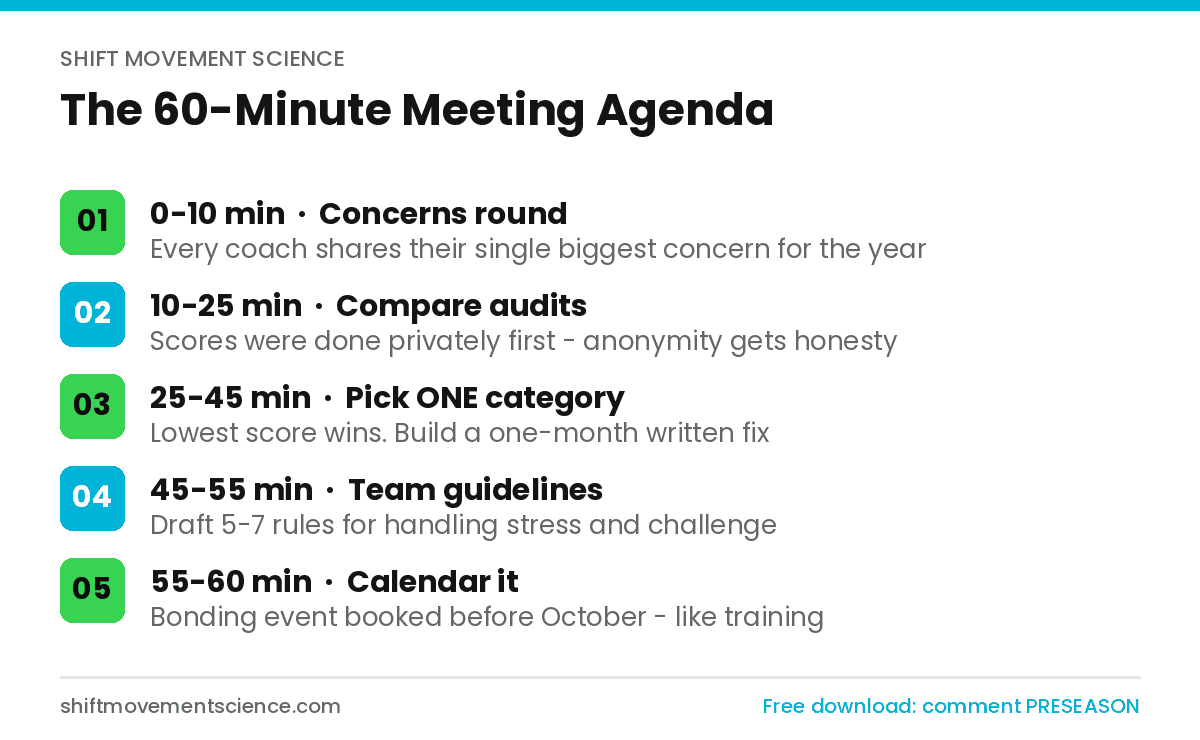
Minutes 0–10 — Set the frame. The head coach opened with one line: “We’re not here to grade each other. We’re here to get one honest picture of where we actually are.” This matters more than it sounds. Coaches will sandbag an audit the moment it starts to feel like a performance review.
Minutes 10–25 — Compare scores by category, not by coach. Instead of going person by person, the group looked at each of the five categories in turn and shared the range of scores (lowest to highest) without naming who gave which number. This surfaces disagreement — sometimes a wide spread inside one category is more informative than the average itself. If three coaches score Athlete Voice a 12/15 and one scores it a 5/15, that gap is worth a conversation on its own.
Minutes 25–40 — Identify the single lowest-scoring category as a group. Not two categories. Not three. One. This gym’s lowest average landed in Athlete Voice — coaches realized athletes had almost no formal way to flag a concern outside of catching someone in the hallway between rotations.
Minutes 40–55 — Build a one-month plan for that one category only. The plan doesn’t need to be complicated. This staff decided on two concrete moves: a suggestion box by the front desk that any athlete could use anonymously, and a standing 5-minute check-in at the start of each week where the coach on duty asked the group directly, “Is anything about how we’re running practice not working for you?”
Minutes 55–60 — Confirm the re-score date. Six to eight weeks out — enough time for a genuine pattern to either take hold or reveal itself as talk. Put it on the calendar before anyone leaves the room.
Five categories worked on halfheartedly is a poster on the wall. One category worked on for real is a culture shift.
Protocol 3: The Athlete 1-on-1 That Reverse-Engineers the Season
The staff meeting sets the frame for coaches. This next protocol sets it for athletes, and it happens individually, in the first two weeks of pre-season, 10–15 minutes per athlete.
The format is simple and works in reverse from a normal goal-setting conversation:
- Start with the season’s biggest event. Ask the athlete to name it themselves — the meet, the level, the skill they most want walking out of this season.
- Work backward one layer at a time. What would need to be true a month before that event? A month before that? What does that mean has to happen this month?
- Land on 2–3 concrete actions for the next four weeks — not vague (“work harder”) but specific and checkable (“hit 5 clean tumbling passes into a pit before moving them to floor,” “get comfortable naming when something feels off instead of pushing through it”).
- Close by asking what would make them feel safe raising a concern mid-season. This single question does more for Athlete Voice scores than almost anything else on the audit, and it costs nothing but the willingness to ask it.
This protocol does two things at once. It gives the athlete ownership over their own season instead of just receiving a plan handed down to them. I plan for 30-minute slots with each athlete who is at the right age/maturity to understand these conversations. We were able to get our team of 30 optionals across 3 days, with two coaches in the meeting and then structured open gym with another coach to maintain productivity. And it gives the coach real information — about goals, about fear, about what “safe” actually means to that specific kid — that a staff meeting alone will never surface.
Protocol 4: Setting 5–7 Team Guidelines
Somewhere in the first two weeks, get the whole team in a room — athletes this time, not just coaches — and build a short, explicit list of guidelines everyone has heard out loud and agreed to. Not a punishment list. A short list of how the group treats each other.
Keep it to 5–7 lines, no more. A guideline nobody can recall isn’t a guideline, it’s decoration. One example line that’s worked well across gyms: “Anyone can say anything, as long as it’s respectful and honest.” That single sentence does real work — it gives athletes explicit permission to speak up (reinforcing the Athlete Voice work from the 1-on-1s) while setting a clear boundary on how.
Write the final list somewhere visible. Revisit it once a month, not just in September.
Protocol 5: The Bonding Calendar
Culture isn’t only built through hard conversations and audits. It’s also built through the parts of the season that have nothing to do with training at all — a game night, a potluck, a charity day, anything that gets the team together outside the walls of the gym.
Put at least one of these on the calendar per month for the pre-season stretch, scheduled in advance rather than left to happen if there’s time. Time never appears on its own in a gym schedule; it has to be claimed ahead of the season getting busy.
Fear can produce a response pattern. It cannot produce a career. Bonding is the glue that makes hard training feel worth showing up for.
Back to that Monday
Six weeks after that first meeting, the same five coaches sat in the same circle and re-scored the audit. Athlete Voice had moved from a 12 average to a 19. Nobody declared victory — the suggestion box still got used sparingly, and the weekly check-in sometimes felt like a formality when the gym was behind schedule. But something had shifted. Athletes were flagging small things before they became big things. A parent conversation that would have blindsided the staff in August got handled calmly because someone had raised it two weeks earlier.
None of that happened because the staff cared more in October than they had in August. It happened because they’d made caring checkable.
Build Your Culture System This Week
1. Grab the free download. The 25-Box Pre-Season Checklist — including the full Culture pillar with all five items ready to run. You can download it here for free!
FREE Gymnastics
Pre Season Checklist
Gymnastics season is coming quickly! Get my "must-have" tips to set up your best competition year yet.
2. Take the free course. For a deeper walkthrough of building healthy gym culture from the ground up, the Essentials of Gymnastics Coaching course is free at shiftmovementscience.com/freecoaches/.
3. Go deeper in The Hero Lab. Full audit templates, 1-on-1 question banks, and month-by-month culture-building plans live inside The Hero Lab. Use code HEROINSIDER for 25% off your first month.
References
- Ruddock, N. — guest contribution on turning toxic gym environments into world-class cultures
- Lloyd, R. & Oliver, J. (eds.) — Strength and Conditioning for Young Athletes: Science and Application (youth development context)
- Haff, G. & Triplett, N.T. (eds.) — NSCA’s Essentials of Strength Training and Conditioning
- Mountjoy, M. et al. — IOC consensus statement on Relative Energy Deficiency in Sport (mental/emotional wellness overlap with culture)