

I want to start with something I don’t say often enough.
The overwhelming majority of gyms I work with are full of people doing this beautifully.
I have coaches who text me at 9pm on a Tuesday to ask whether a kid can start rope climbs yet. Gym owners who rearrange an entire rotation so an athlete in a boot still has somewhere to belong. Parents who drive four hours round trip to an appointment and then ask, genuinely, “what can he do?” instead of “what can’t he?” I’ve watched coaches sit down on the floor beside a crying twelve-year-old and just be there, because that was the only thing that was going to help that day.
Those people are the reason kids stay in this sport.
Athletes remember who showed up when they were hurt far longer than they remember who spotted their first double back.
That said — I consult with programs around the country, and a handful of times a year I run into an injury being handled in a way that’s quietly doing real damage.
Almost never out of malice. Usually it’s fear, or not knowing what’s allowed, or being genuinely busy and letting something slip.
But the cost lands on a kid. So here are the five patterns I see most, and what to do instead. Not as criticism — as a playbook.
An injury changes what a gymnast can do. It shouldn’t change whether they belong.
Table of Contents
The five, in one line each
- Don’t hang your identity — or theirs — on gymnastics. Humans first, gymnasts second.
- Don’t isolate them in the corner of the gym. Keep them in practice, not adjacent to it.
- Don’t assume everything is off-limits. Ask what they can do and program around it.
- Don’t make the athlete the messenger. Adults communicate with adults.
- Don’t treat “medically cleared” as ready for full training. Budget twice the time they were out.
1. Don’t hang your identity — or theirs — on gymnastics
I’m putting this first because everything else follows from it.
What I see: A coach whose sense of professional worth rises and falls with the team’s scores. A parent whose family identity has quietly become “we’re a gymnastics family.” And an athlete who somewhere along the way stopped being a kid who does gymnastics and became a kid who is a gymnast.
None of that comes from a bad place. Coaches care enormously. Parents have invested years, money, and most of their weekends. Athletes love this sport. That investment is real, and it usually means people care deeply.
But it creates a problem — and the problem shows up most sharply the moment someone gets hurt.
If an athlete’s whole identity is “gymnast,” an injury isn’t an inconvenience. It’s an identity crisis. They don’t just lose training time; they lose their sense of who they are. I’ve watched kids handle a torn labrum with total composure and then come apart over a much smaller question:
“If I’m not doing this, what am I?”
And if the adults’ identity is riding on their performance, they can feel it. Kids always feel it.
It changes what they’re willing to tell you. They’ll minimize pain. They’ll say they’re cleared when they aren’t. They’ll keep going long past the point of wanting to, because stopping feels like it would disappoint people they love.
That is an enormous weight to hand a thirteen-year-old.
What to do instead — make it unmistakable that the person matters more than the participation:
- Say it before it’s needed. The time to tell an athlete they’re valued beyond gymnastics is not the day they get hurt. It should be so well established it’s boring.
- Ask about the non-gymnastics stuff. How the test went. How school feels. What else they’re into. Ten seconds, and it signals the entire value order.
- Normalize changing direction. Goals change. Bodies change. Interests change. An athlete deciding at fifteen that they want a different relationship with the sport is not a failure — not theirs, not yours.
- Build real off-ramps that keep them in the community. Coaching younger groups. Judging. Choreography. Team management. Or just being a kid who still comes to open gym because their friends are there.
- Check yourself honestly. If they told you tomorrow they wanted to step back, what would you actually feel? That answer is worth sitting with.
Gymnastics is a voluntary activity people choose because they love it — even at the elite level. It’s a passion, an interest, a hobby some pursue very seriously. It is not a person’s worth.
We are humans first and gymnasts second.
No athlete should ever feel that scaling back, moving on, or taking a different role in the gym means losing their friends, their community, or their standing.
This matters most for athletes who’ve stacked injury on injury. Those kids often carry guilt on top of pain — like their body has let everyone down.
Our job is to make sure they know it hasn’t.
2. Don’t isolate them in the corner of the gym
What I see: An athlete comes back with PT instructions and gets set up in the far corner, facing a wall, working through a printout alone. Practice happens somewhere behind them. Three days a week, for six weeks.
I understand exactly how this happens. The coach is running a rotation, the athlete has a program, and the corner is out of the way. It looks like accommodation. It’s efficient.
But look at it through their eyes.
She’s twelve. Gymnastics isn’t just her sport — it’s where her friends are, where she has status, where she knows the rules and feels competent. The injury already took her body from her.
Now the setup takes her people, too.
She spends six weeks watching teammates learn skills she’s falling behind on. Alone. Facing a wall.
What to do instead — get them in practice, not adjacent to it:
- Do the PT program on the floor, near their group. Same room, same energy, same conversations. Not in exile.
- Give them a role. Counting numbers, filming for video review, checking shapes on a younger group, calling out corrections they’ve heard a hundred times.
- Keep them in the rituals. Modified warm-up lines, team huddles, the end-of-practice circle.
- Let them coach a little. Injured athletes often become the sharpest technical eyes in the gym, because for once they’re watching instead of doing.
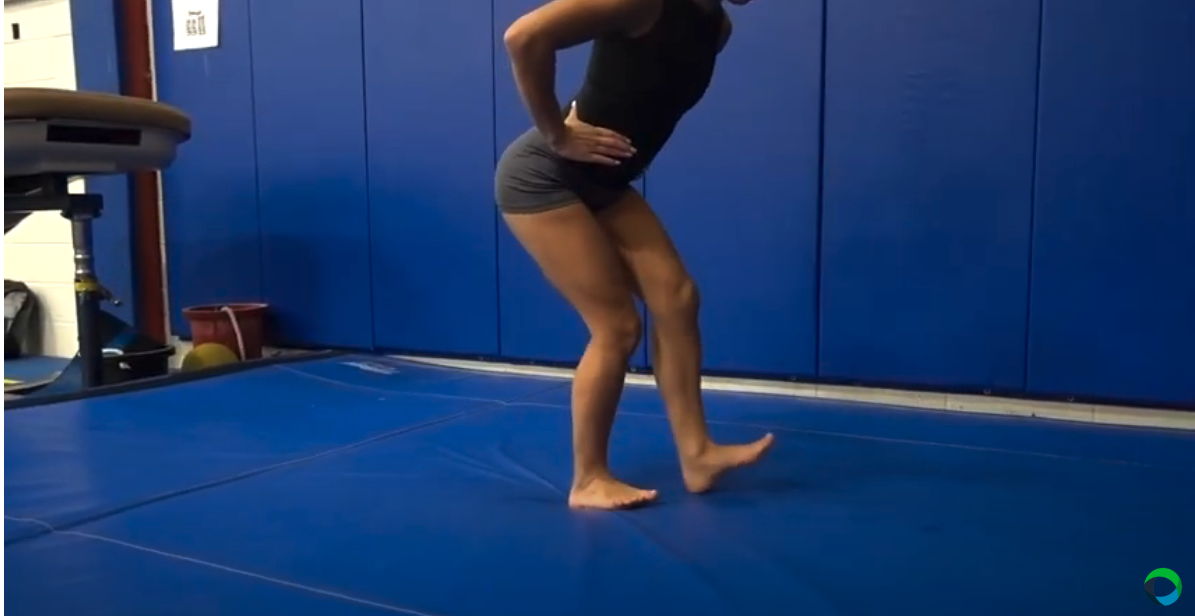
A gymnast’s peer group is either the biggest buffer against stress or its biggest generator — it’s rarely neutral. An injured athlete is the clearest test of which one your gym is.
The worst thing we can do is take a hurt kid out of their friendships and treat them like an isolated piece.
3. Don’t assume everything is off-limits
What I see: “He’s hurt, so he’s not doing anything until the doctor clears him.” Six weeks of essentially nothing — then a return to full training with a deconditioned athlete who is now at higher risk than the day he got injured.
I get the instinct. It feels like the safe choice.
But “rest everything” usually isn’t caution — it’s an absence of information. And it costs real fitness, real strength, and real confidence.
What to do instead — ask what they can do, and program around it:
Almost every injury leaves most of the body available.
- Ankle sprain or hip injury? Build an upper-body block — pulling, pressing, shaping, core. For the boys, this is a great window for rings and parallel bar strength positions. Get creative with seated and supported work.
- Shoulder, elbow, or wrist issue? This is the moment for leg strenwth, hip flexibility, and core control that respects the restriction. Plenty of beam and floor athletes have come back with the best legs of their lives.
- Almost anything? There’s nearly always room for pre-hab on the keystone areas, bracing and breathing work, and flexibility that doesn’t load the injured tissue.
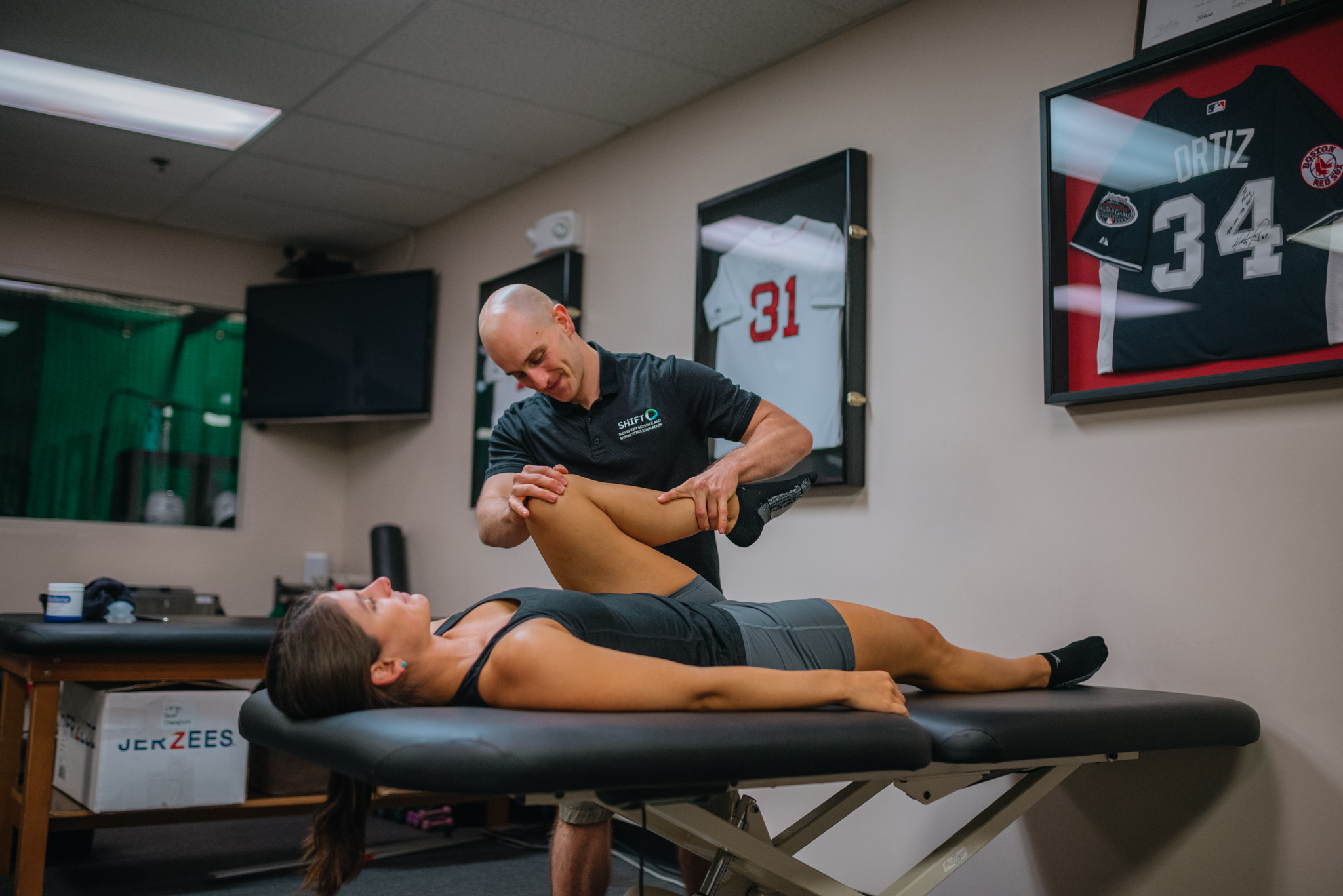
Here’s the reframe that changes everything:
An injury is often the best strength and conditioning window an athlete will get all year.
They suddenly have time, they aren’t fighting skill fatigue, and they’re motivated. Some of the biggest jumps I’ve seen in an athlete’s physical profile happened during a rehab block — because someone finally programmed for them.
And you don’t have to guess at what’s safe. Which brings us to the next one.
4. Don’t make the athlete the messenger
What I see: The coach knows one version of the plan. The parent knows another. The PT wrote a third. And the person expected to reconcile all of it is a thirteen-year-old, standing between rotations.
That isn’t fair, and developmentally it isn’t realistic.
Kids are not reliable medical translators. They’ll tell you what they think you want to hear. They’ll leave out the parts that scare them. And they will absolutely say “yeah, I’m cleared” if they think it gets them back on beam or back up on high bar.
This is the one I feel most strongly about, so let me be direct:
It is the adults’ job to communicate with each other.
What to do instead — build a direct line between the grown-ups:
- Get the PT’s contact information and use it. A text saying “he’s asking about back tumbling — where are we with that?” takes ninety seconds.
- Use a shared document. A simple Google Doc with current restrictions, cleared skills, and the next milestone — visible to coach, parent, and provider — removes most confusion in one step.
- Loop in the athletic trainer if you have one, and the parent always.
- Set a rhythm. A short update every two weeks beats a panicked phone call the day before a meet.
Here’s what convinced me this is always possible. I have surgeons — people whose day is literally operating on human beings — who scrub out, pick up the phone, and leave me a voicemail with an update on an athlete.
If they can find ninety seconds, I can find ninety seconds to text a coach. So can all of us.
When the adults talk, the athlete gets to go back to just being an athlete. That alone lifts an enormous weight off a hurt kid.
5. Don’t treat “medically cleared” as ready for full training
What I see: An athlete gets cleared on Tuesday and is doing full bar routines by Thursday. Two weeks later there’s a new problem — often somewhere completely unrelated — and everyone is confused about why.
This might be the most common way a good rehab gets undone.
Here’s the gap. When a doctor or PT says “cleared,” what they usually mean is the injured tissue has healed enough to tolerate loading. That’s a real and important milestone.
But it is not the same as this athlete is ready for twenty-five routines, four to six events, and eighteen hours a week.
Those are two different statements — and the second one isn’t really a medical question. It’s a training question.
And let me say this part carefully, because it isn’t a criticism: many athletic trainers, physical therapists, and physicians are excellent at their craft but don’t know gymnastics deeply. That’s completely reasonable.
If an elite downhill skier walked into my clinic tomorrow, I could rehab the knee — but I would not be the right person to build their return-to-snow progression. I’d know enough to go find someone who lives in that sport. Expecting your PT to know what a half-in half-out or a full pommel routine costs the body is a bit like expecting me to know race-line mechanics.
Nobody specializes in everything. Which means the graduated return is usually our job — coaches and gymnastics-literate providers, working together.
What to do instead — build a deliberate ramp, and budget real time for it:
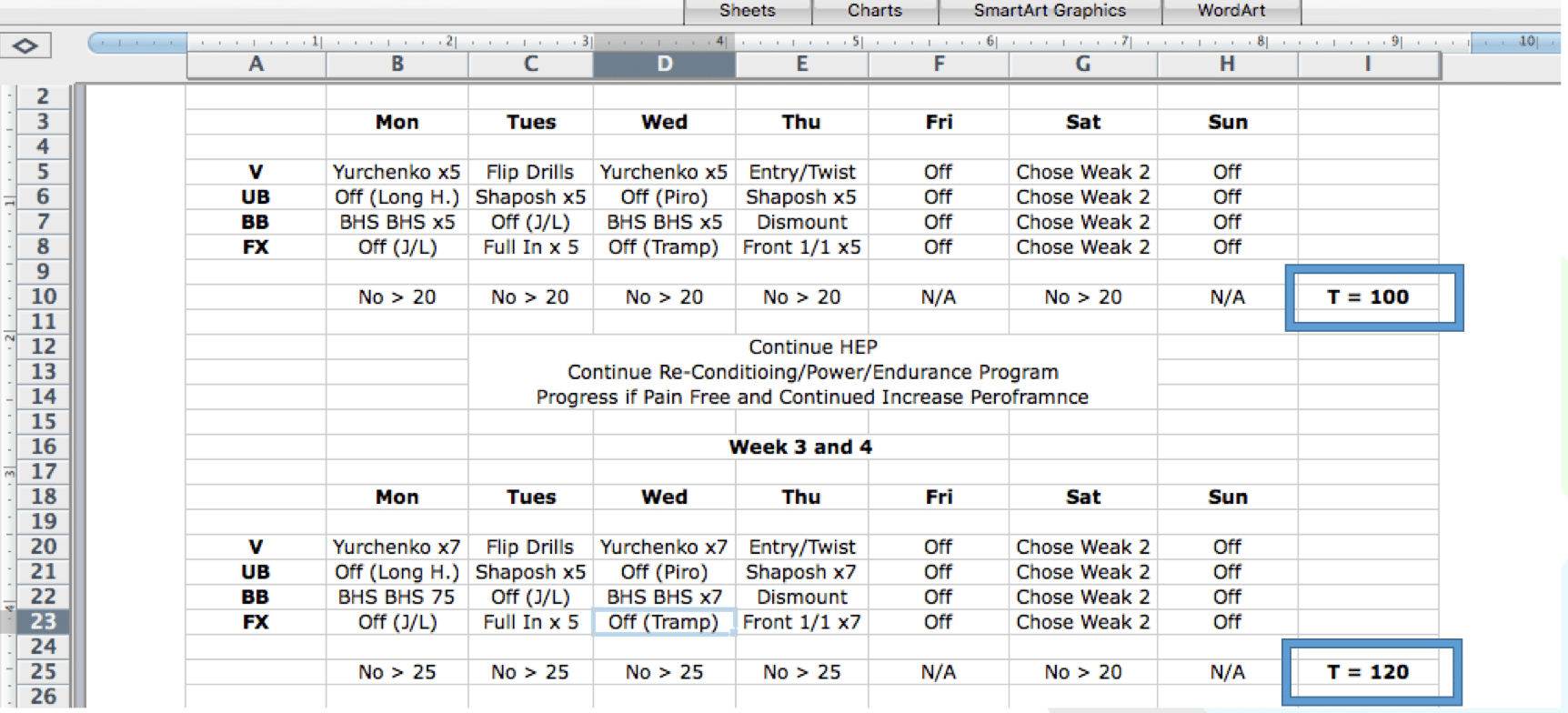
Plan for at least twice the time they were out. Four weeks off means four to eight weeks of rebuilding. Not four days.
A simple structure:
- Weeks 1–2 back: basics, shapes, drills, strength and conditioning. Rebuild the engine before the routines. This is also where you find out what actually got weak.
- Then move one dial at a time. Volume, intensity, and difficulty are three separate variables. Raise one, hold the others, watch what happens. Adding numbers and difficulty and hours in the same week is how re-injuries happen.
- Drills before skills. Numbers before difficulty. Let them earn volume on what they own before layering on the hard stuff.
- Watch the 24-hour response, not just how practice went. Soreness that lingers into the next day is your signal to hold.
- Keep the PT or AT in the loop through the ramp, not just up to the clearance date. The most useful conversation often happens two weeks after clearance.
This is the same principle I hammer in workload planning:
Planned time off isn’t what causes injuries. Aggressive spikes in training volume are.
An athlete returning from six weeks out and jumping straight to full load is the single biggest volume spike of the entire training year. We just don’t see it that way, because it feels like getting back to normal.
It isn’t back to normal. It’s a brand new build.
The thread running through all five
Every one of these comes back to the same order I try to hold in everything:
Health first. Then great humans. Then great gymnasts.
An injured athlete is where that order gets tested — because it’s the one moment when the “gymnast” part temporarily can’t deliver anything for you.
What you do in that window tells them, and every teammate watching, what you actually believe. Kids are extremely good at reading this. They notice who gets forgotten.
And the stakes are real. In a single season working with local programs I saw 34 gymnasts with stress fractures or overuse tears, 20 who lost their entire competitive year, and 12 who left the sport altogether.
Not all of that is preventable. But a meaningful share of the leaving isn’t about the injury at all — it’s about what the injury felt like socially.
An athlete who stays connected through six weeks out usually comes back. An athlete who spends six weeks alone in the corner often finds a reason not to.
And for the ones who don’t come back — the athletes whose injuries stacked up, or whose goals genuinely changed — the measure of a gym isn’t whether it kept them competing.
It’s whether they still feel welcome walking through the door. If a former gymnast stops by at Christmas to say hi to their old coaches, you did this right.
If this resonated, send it to one person — a coach in your gym, a parent on your team, or the gym owner who sets the tone. Most of what’s in here costs nothing but a decision.
And if you want the tools behind it — return-to-sport frameworks, modified conditioning programs by injury type, and the communication templates I use with the gyms I consult for — that’s much of what I’ve built inside The Hero Lab. Use code HEROINSIDER for 25% off your first month.

But honestly? Most of this is free. It costs a text message, a spot on the floor instead of the corner, and a decision that a hurt kid is still one of yours.
— Dave
Dr. Dave Tilley, DPT, SCS, CSCS — SHIFT Movement Science