
Let me start with a mistake I made for years: long running workouts and panel-mat plyo lines as “off-season cardio.”
It felt like hard work, so it felt productive. But there’s a principle underneath this — the SAID principle (Specific Adaptation to Imposed Demands). Adaptations are specific to the exact demand you train. A gymnast grinding out laps is developing a low-intensity, long-duration engine the sport never actually asks for, while stacking ground impacts and injury risk in the process.
The off-season is your primary window to build the athlete’s engine. Do it well and you get better routine performance, more energy for repeated drills and turns, faster recovery between routines at meets, and athletes who hold their quality across a long training week. Here are the five things I want coaches to understand, with the physiology underneath.
Table of Contents
1. Know exactly why off-season conditioning matters
Conditioning isn’t punishment or filler — it’s a performance and recovery tool. A well-conditioned gymnast gets five specific benefits:
- Better routine performance in season
- Enough energy supply for repeated drills, skills, and turns in practice
- Faster recovery between routines at meets
- The ability to maintain energy across a long practice and training week
- Faster recovery between training sessions
Frame it that way for your athletes and it stops being “the part we hate” and becomes the thing that lets them do everything else better.

2. No fuel = no training effects
This is non-negotiable, and it’s where most off-season plans quietly fall apart. Off-season cardio, strength, and skill work is tough, and it’s overwhelmingly fueled by carbohydrate — gymnastics is a glycolytic, anaerobically-biased sport. If athletes aren’t refilling that tank, the adaptations never show up and quality craters in the back half of practice.
So teach it, don’t assume it. Teach athletes to fuel with high-quality food and to eat enough to train hard. They typically need more water in the off-season, too. And coach the outside factors: no 8-hour beach trip right before practice, real sleep, and basic self-care. Without this foundation, everything goes down the tubes fast — no matter how good the program is.
3. Train specificity: the goal is a 60–90 second gymnastics-specific effort
Here’s the reframe that changed how I program. A gymnastics routine or a dense block of turns is essentially a 60–90 second maximal effort — that’s the glycolytic time domain. So the aim of conditioning is to set the foundation of the entire body working really hard in a 60–90 second, gymnastics-specific setting, because that’s the demand the sport actually imposes.
It’s not that a running workout is evil; switching it up once in a while is fine. But be honest about two things: the number of ground impacts you’re stacking, and whether you’re spiking training volume. Specific, repeatable, controllable conditioning beats junk mileage every time.

4. Use the model: 8 weeks mixed aerobic, then a 4-week transition to burst anerobic
Here’s the structure I use now after years of trial and error.
Weeks 1–8 — General aerobic base. More moderate intensity for longer periods, with a variety of movements, blending gymnastics-specific and general fitness, roughly 2x per week to complement — not compete with — regular training.
Weeks 9–12 — Transition to burst/anaerobic work. Get a “rolling start” into preseason: progressively increase plyometrics and ground contacts, funneling those aerobic adaptations into what routines actually demand.
“But gymnastics is a burst sport — why train aerobic at all?” Because recovery is aerobic. After a short maximal effort, your body has to resynthesize phosphocreatine and clear metabolic byproducts, and that process is oxygen-dependent — it runs on the aerobic system.
A bigger aerobic base means faster recovery between turns, between routines, and between training bouts. This is the same repeated-effort physiology laid out in MacDougall and Sale’s Physiology of Training for High Performance. Build a higher work capacity over a longer time domain and you get better practice and in-season performance — and, theoretically, reduced injury risk from fatigue.
5. Run it as circuits — and progress it on purpose
Here’s the practical how-to. I use circuit-based conditioning, 15–20 minutes, 2x per week.
- Format: 2 rounds of 8–12 stations (16–24 minutes total), starting at 40 seconds on / 20 off.
- Setup: solo for ~10 athletes, or partners for 20–30. Rotate upper, core, lower, and gymnastics-specific stations.
- Variety: build two different circuits, one for each day, and change them monthly. Run a 3-on / 1-off monthly rhythm.
- Denser conditioning: program triplets/mini-circuits so nobody stands around waiting for equipment — it keeps heart rate elevated while rotating upper/lower/core for local recovery. Perfect for a cramped gym with staff spread out.
Then progress it deliberately across the 8 weeks on three levers:
– Time intervals: 40/20 → 45/15 → 50/10 (shrinking the rest raises the metabolic demand)
– Exercise demand: air squat → goblet squat → squat jumps
– Reps: keep quality high and aim for 1–2 more good reps per station
If you only get 2–3 days a week with a less intense group? Design one or two 15-minute circuits, keep the exercises fun and general (not high-demand), spread the movements through the week, and set it to music they like.
Two last coaching notes that make or break adherence: communicate the why and ask for athlete input, be genuinely open to feedback, do the circuits with them, respect your on/off days and weeks — and don’t be afraid to play a game once in a while (Ships and Sailors, an obstacle course, a Tumbl Trak conga line). Buy-in is a training variable too.
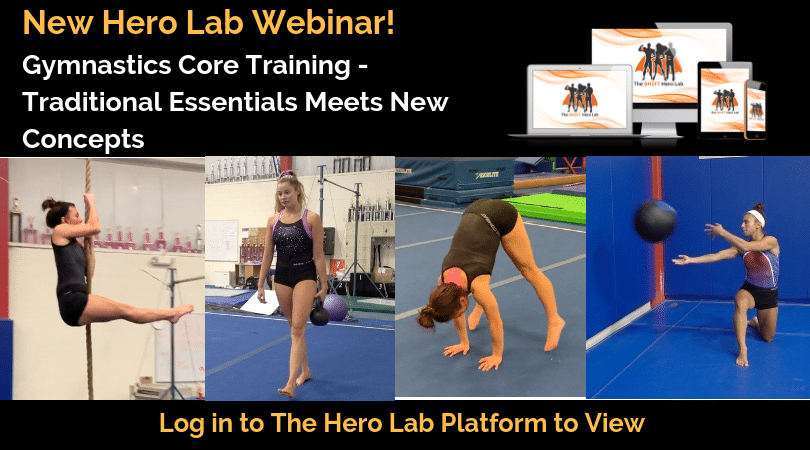
Want the circuits, station libraries, and the full 8+4 week template ready to run? That’s exactly what lives inside The Hero Lab — the conditioning circuits, the progressions, and the programming I use with the gyms I consult for.
If you’ve been curious, use code HEROINSIDER for 25% off your first month, and build your summer conditioning block this week instead of defaulting to another season of running lines.
Click HERE to learn more
— Dave
Dr. Dave Tilley, DPT, SCS, CSCS — SHIFT Movement Science
References & Further Reading
- MacDougall, D. & Sale, D. The Physiology of Training for High Performance (Oxford).
- Jemni, M. (ed.). The Science of Gymnastics: Advanced Concepts (2nd ed.).
- Haff, G. & Triplett, N.T. (eds.). Essentials of Strength Training and Conditioning (NSCA, 4th ed.).
- Turner, A. & Comfort, P. (eds.). Advanced Strength and Conditioning: An Evidence-Based Approach.
- Lloyd, R. & Oliver, J. (eds.). Strength and Conditioning for Young Athletes: Science and Application.