Here’s the thing most coaches miss about the off-season: it isn’t a break from the real work. It is the real work. Once the competitive season starts, you are maintaining what you built — not building. That’s not a motivational line; it’s how adaptation works. Strength and structural changes require a progressive overload stimulus applied over weeks, and the season rarely gives you the recovery headroom to provide it. So the strength, power, and durability your athletes carry into the season were mostly decided in a short summer window.
I’ve spent 15+ years treating and training gymnasts, and the pattern is the same everywhere: the programs that get the off-season right walk into preseason from the penthouse. The ones that wing it walk in from the basement. Below are the five things I want every coach to get right this summer — with a little more of the “why” underneath each one.
Table of Contents
1. Get clear on the three goals of the off-season
Before you write a single workout, name what the off-season is actually for. There are three goals, in order.
Recover. The season is brutal — physically, emotionally, and mentally. Your athletes should start the summer on a full gas tank, not a fumes-and-willpower one. That means a real deload, a medical screen, and permission to be human for a couple of weeks.
Build a robust general athlete. This is your only major ~3-month window to meaningfully increase upper, lower, and core strength, and your only real window to build cardiovascular capacity. This is also where the Long-Term Athletic Development model (Lloyd & Oliver) earns its keep: broad, general physical qualities built early become the platform every sport-specific skill sits on later.
Learn new drills, skills, and upgrades. It’s the one stretch of the year where you can teach skills from scratch across every event without the pressure of an upcoming meet.
If a summer plan doesn’t clearly serve those three, it’s just busywork with a practice clock.
2. Yes, gymnasts should lift weights — and the science ends the “myth” arguments
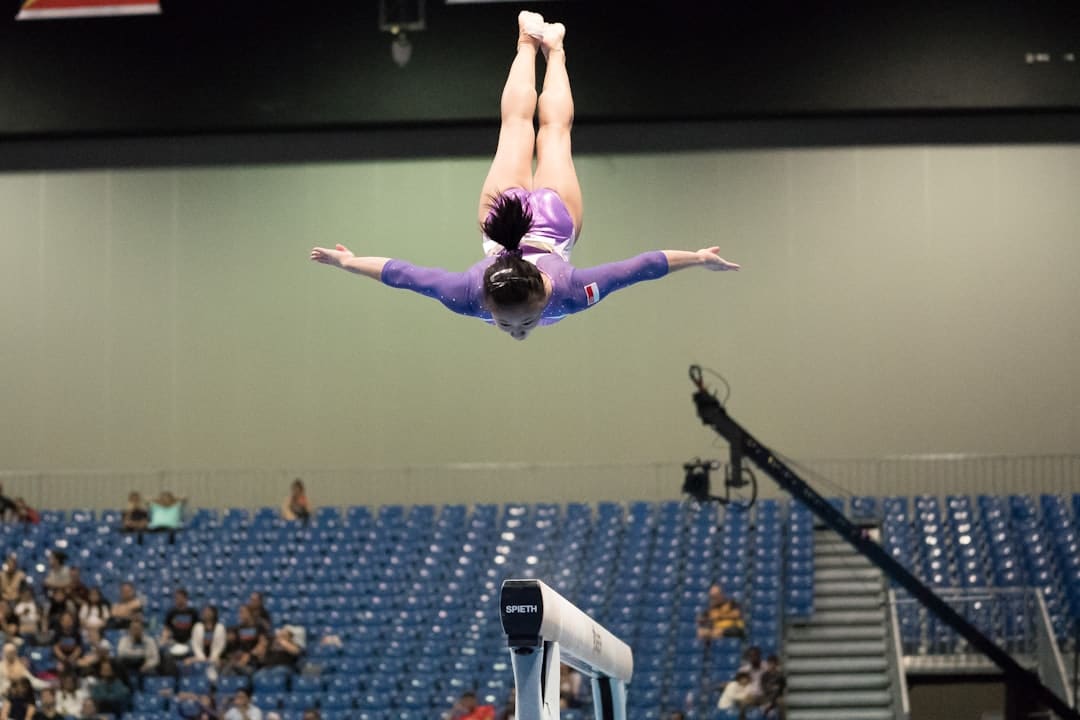
Let me be direct, because this is where most programs stall: gymnasts should lift weights. Absolutely. And the mechanisms are well established in the NSCA’s Essentials of Strength Training and Conditioning.
The forces a gymnast absorbs are up to 15x bodyweight on landings and blocks. Bodyweight strength alone will not build the tissue capacity to tolerate that, especially in the arms. And remember what actually drives athleticism: force. Strength training with external load is the most reliable way to raise maximal force output, and expressing that force quickly — rate of force development — is what we call power. You cannot express force you never built.
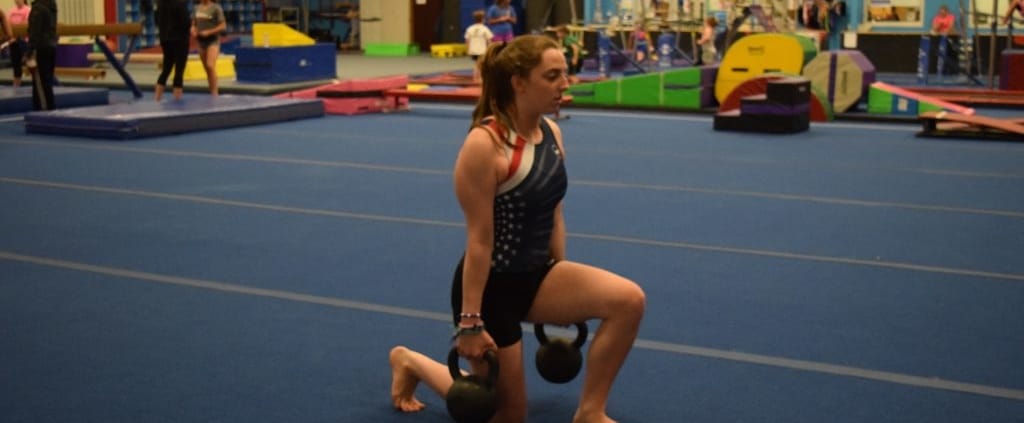
So why hasn’t gymnastics fully embraced it? Fear of the unknown, lack of education, and assumptions winning out over evidence. Every objection is a programming myth, and the research answers each one:
- “They’ll get bulky.” Hypertrophy is a function of volume, intensity, and nutrition — you only get it if you program for it. General strength work in the rep ranges below builds strength and neural qualities, not size.
- “They’ll lose flexibility.” Acutely, maybe. Long-term, the opposite: eccentric training has been shown to increase muscle fascicle length, which supports — not steals — range of motion.
- “They’ll get hurt.” The international consensus on youth resistance training (Lloyd, Oliver, and colleagues) is clear: supervised, well-programmed resistance training is safe for young athletes and is associated with reduced injury risk. It’s a little hypocritical to fear a controlled goblet squat when the sport already loads the body at 15x bodyweight every day.
3. You must have a plan — and it scales to your days per week
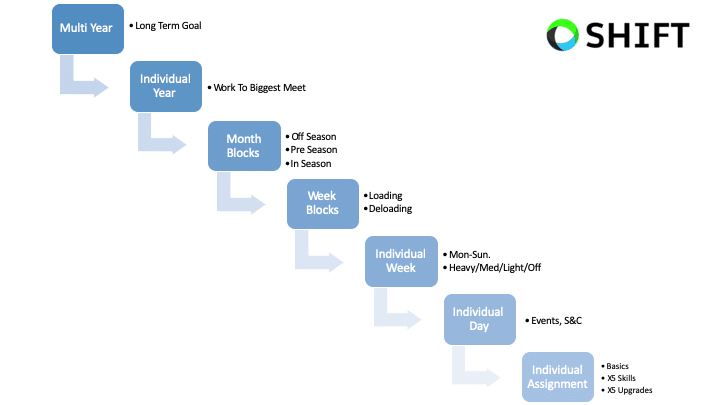
The number one rule: have a plan. The second: match it to your actual training days. It’s referred to as “periodization” in the scientific terms. Here’s how I scale it based on level and how many days you are in the gym.
- 6 days: 2 heavy, 3 medium, 1 light, 1 off — 3 days gymnastics strength, 2 days general fitness, 1 day pre-hab.
- 5 days: 2 heavy, 2 medium, 1 light — 2 gymnastics, 2 fitness, 1 pre-hab.
- 4 days: 2 heavy, 1 medium, 1 light — 2 gymnastics, 1 fitness, 1 mixed.
- 3 days: 2 heavy, 1 medium — lean on a home program to fill gaps.
- 1–2 days: 1 heavy (plus 1 medium) and a home program to carry the rest.
Then balance the program. On the fitness side, hit every basic human movement pattern: squat, hinge, single-leg, push, pull, and 3D core — the same foundation Michael Boyle’s functional training work is built on. On the gymnastics side: CHS/handstand work, rope, shapes and shaping changes, “stiffness” drills, open/close shoulder work, and men’s and women’s event-specific strength.
4. Periodize the sets, reps, and volume — don’t just “do hard stuff”
Loading should change as the summer progresses. This is the core principle from Bompa’s Periodization: move from general to specific, and as intensity climbs, volume comes down. That inverse relationship is the whole game.
Early off-season (build volume and quality movement):
– 3–4 sets of 8–12 for general strength and fitness
– 2–3 sets of 5 if maintaining power quality
– 2–3 sets of 30 seconds for gymnastics shaping and holds
– 2 sets of 10 for accessory pieces
Later off-season (raise intensity, funnel toward preseason):
– 3–4 sets of 5–8 for higher-intensity strength
– 2 sets of 20–30 seconds for shaping
– 2 sets of 10 for accessory
Structure it as 3 weeks on, 1 week deload, repeated three times — a clean 9-week summer block that builds and recovers instead of grinding straight through. Those planned deloads aren’t lost time; they’re when the supercompensation you trained for actually shows up.
5. Build the system, then tinker
A great program that no one can run is worthless. So I build it in steps.
Step 1: meet with your coaches and team — what went well, what didn’t (bars struggled, knees got cranky mid-year, girls felt wrecked doing heavy strength and cardio the same day), and what you need most.
Step 2: plan the deload — 1–2 weeks off after the last meet, then a light ramp back, plus a medical screen and a fresh pre-hab sheet.
Steps 3–4: build the monthly, weekly, and daily programs off your real schedule.
Step 5: build the implementation system — binders, staff-led circuits with a timer, partner stations, or a strength coach.
Step 6: run it, then tinker — swap exercises for the athlete who needs it, adjust to your time, staff, and space, and actually read the tracking sheets.
And if no one’s on board yet? Don’t argue — educate. Talk about the myths, the reduction in gym stress and headaches, the performance gains, and the reduced injury risk. Then ask honestly: is this a good fit for us?
Want the actual programs, not just the framework? This is exactly what I go deepest on inside The Hero Lab — the full off-season strength templates, the fitness and gymnastics-specific exercise libraries, the day-by-day splits, and the tracking sheets my consulting programs use.
If you’ve been meaning to check it out, use code HEROINSIDER for 25% off your first month. Build the plan this week and give your athletes a summer that actually raises their ceiling. Click HERE to learn more
— Dave
Dr. Dave Tilley, DPT, SCS, CSCS — SHIFT Movement Science
References & Further Reading
- Bompa, T. & Buzzichelli, C. Periodization: Training for Sports (3rd ed.).
- Haff, G. & Triplett, N.T. (eds.). Essentials of Strength Training and Conditioning (NSCA, 4th ed.).
- Lloyd, R. & Oliver, J. (eds.). Strength and Conditioning for Young Athletes: Science and Application.
- Jemni, M. (ed.). The Science of Gymnastics: Advanced Concepts (2nd ed.).
- Caine, D., Russell, K. & Lim, L. (eds.). Handbook of Sports Medicine and Science: Gymnastics (Wiley-Blackwell).
- Boyle, M. New Functional Training for Sports (2nd ed.).
- MacDougall, D. & Sale, D. The Physiology of Training for High Performance (Oxford).