

Here’s the thing most coaches feel but rarely say out loud: a great competitive season is usually decided months before the first meet.
Not by talent, and not by how hard anyone trains in the moment — but by the plan. Periodization is that plan. It simply means creating and following a road map for the season. What days are light, medium, or heavy intensity. What weeks are practice weeks, mock meet weeks, or competition weeks. What months are focused on skills and combinations, or full routines.
In the hundreds of programs and gymnasts I’ve consulted with, I’ve found it’s the difference between athletes who peak at nationals and athletes who completely run out of gas mid season.
The good news is that it’s learnable, and once you have the framework, it makes every other decision easier. Here are the five things I want every coach to understand.
Table of Contents
1. Periodization is just planning and fluctuating loads on purpose
Strip away the jargon and periodization simply means planning and fluctuating your training loads over time.
It’s not smart, and not possible, to simple train hard every single day expect athlete’s to need a break. It’s not only the gym that athlete’s are stressed by. It’s also schoolwork, friends, family, and many other factors pulling from that same stress well.

It all comes down to dosage. The right dose of stress plus the right dose of recovery equals adaptation. I use the aspirin analogy: aspirin helps a headache — unless you take zero, or unless you take forty. Too little training and there’s no adaptation, and your athletes aren’t prepared. Too much and you get poor performance, injury, and burnout. Periodization is how you find and hold that window across a whole year instead of guessing week to week.
2. Start from the biggest meet and work backward
This is the single most useful habit in yearly planning: start from your most important competition and plan backward.
Everything zooms from the big picture down to the daily assignment — multi-year goals, then the individual year, then month-long blocks (off-season, pre-season, in-season), then week blocks (loading and deloading), then the individual week (Monday-to-Sunday, heavy/medium/light/off), then the day, then the individual assignment (basics, five skills, five upgrades).
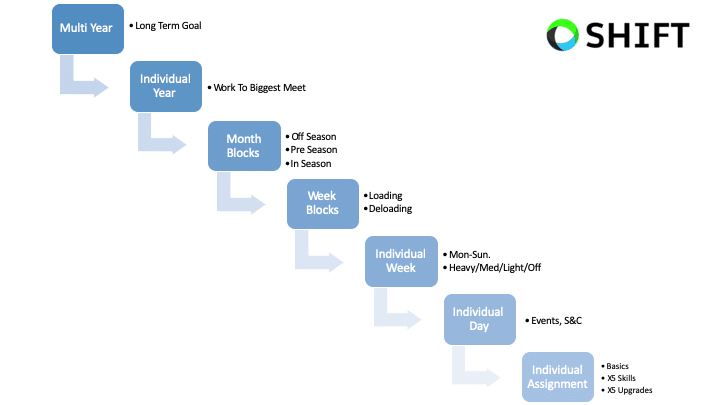
A realistic map might run like this
Off Season – June to August
Pre-Season – September to November
In Season A – December to February
In Season B – March to May
When you build backward from the peak, every block has a clear job — and you stop asking your athletes to be at their best twelve times a year.
3. You’re always juggling four things — periodize all of them
Across the entire year, you are managing four categories at once: gymnastics performance, strength, energy systems/cardio, and athlete wellness. The art of periodization is shifting the emphasis of each as the season changes.
- Off-season: skills and drills, max strength (about 50% general / 50% gymnastics-specific), a general aerobic base (circuits and intervals), and movement screening plus individual pre-hab.
- Pre-season: skill combinations building to half and then full routines, a shift toward maintaining strength and power, “burst” anaerobic capacity, and recovery education.
- In-season A & B: full routines and peaking, strength and power moved to 100% gymnastics-specific maintenance, anaerobic performance work, and a real increase in preventative care and recovery.
Same four dials, turned differently in each block. That’s the whole game.

4. Load in waves — and never go hardest on Monday
Inside each block, structure the weeks in waves. A classic off-season microcycle runs three weeks of loading, then one deload week — for example Learn/Load, Load, Load, Deload. Within an individual week you rotate intensities: heavy, medium, light, and off days, so fatigue never piles up unchecked.

One specific piece of advice I give every coach: strongly avoid going really hard on Monday. Athletes come back carrying accumulated fatigue, and slamming the gas on day one is how you dig a hole for the whole week. And here’s the mindset shift that prevents most injuries — planned time off isn’t what causes problems. Aggressive spikes in training volume are. Deloads and off days aren’t lost time; they’re when the adaptation you worked for actually shows up.
5. Scale the plan to your real training days
A plan you can’t run is worthless, so periodization has to fit your actual schedule. Match the intensity distribution to how many days you train:
- 6 days: 3 heavy, 2 medium, 1 light, 1 off
- 5 days: 2 heavy, 2 medium, 1 light, 2 off
- 4 days: 2 heavy, 1 medium, 1 light, 3 off (consider a home program)
- 3 days: 2 heavy, 1 medium, 4 off (home program)
- 2 days: 2 heavy, 5 off (home program)
- 1 day: 1 heavy, 6 off (home program)
Think principles, not copy-paste. Build your own templates off your real calendar, then tinker as the season teaches you what your athletes actually need.
Want the blank periodization and strength & conditioning templates to build your own year? This is exactly what I break down inside The Hero Lab — the yearly plan builder, the off/pre/in-season mesocycle templates, and the workload science that keeps athletes peaking instead of breaking.
Click HERE to learn more – https://shiftmovementscience.com/theherolab/
You can learn exactly how to plan the entire competitive year, use all our templates, and get step-by-step guidance for what to do this pre season.

Use code HEROINSIDER for 25% off your first month, and map out your season this week instead of winging it.
— Dave
Dr. Dave Tilley, DPT, SCS, CSCS — SHIFT Movement Science
References & Further Reading
- Bompa, T. & Buzzichelli, C. Periodization: Training for Sports.
- Gabbett, T.J. The training-injury prevention paradox: acute-to-chronic workload and injury risk. Br J Sports Med.
- Haff, G. & Triplett, N.T. (eds.). Essentials of Strength Training and Conditioning (NSCA).