
I feel there are 5 myths are quietly running most gymnastics pre-season strength and conditioning programs.
None of them are “bad” — they’re all reasonable-sounding ideas that happen to be wrong, which is exactly why they survive.
This week we’re taking each one apart and replacing it with the actual program blocks from Pillar 3 (Strength & Power) and Pillar 4 (Cardio & Energy Systems) of the 25-Box Pre-Season Checklist — the whiteboard test, the Daily Dozen, the 8+4 conditioning model, and the explosive work that ties it all together.
By the end of this post you’ll have five program blocks you can build into your gym’s schedule starting Monday. No philosophy required — just protocols.
Before we get started, though, if you want my full free preseason checklist right to your inbox to use and get ready, just put your email in below.

FREE Gymnastics
Pre Season Checklist
Gymnastics season is coming quickly! Get my "must-have" tips to set up your best competition year yet.
Table of Contents
Myth 1: “Running builds their cardio for the season.”
The myth: Laps, long jogs, and steady-state running are how gymnasts build the conditioning they need for a season of routines.
The truth: This confuses “tired” with “trained.” The SAID principle — Specific Adaptation to Imposed Demand — means the body adapts to exactly what you ask it to do, nothing more. Long, slow running builds an engine that’s very good at long, slow running. That doesn’t mean that aerobic conditioning doesn’t have a role to play in gymnastics. It definitely does. It’s something that’s more focused on the off-season, when we can use circuits and under methods to build up someone’s overall engine to help them recover from high-intensity bouts that a routine demands.
In the pre-season, long-distance running or 10 minutes of panel mat lines does almost nothing for the actual demand of a gymnastics routine. It stacks ground-impact stress on a body that’s already absorbing enormous forces from landings and heavy tumbling. You end up with athletes who are more fatigued and no more prepared for the event they actually compete.
A gymnast’s summer break doesn’t just cost skills. It costs the engine those skills run on — and running laps doesn’t rebuild the right engine.
The fix — the Whiteboard Test: Before you program a single circuit, write your actual events and routines on a whiteboard and time them. How long does a floor routine take, start to finish? A bar routine? For most gymnastics events, the honest answer lands somewhere in a 60–90 second window of near-maximal effort. That number — not “cardio” as a vague concept — is the actual target your conditioning program needs to hit. Write it down before you program anything else. It’s the single most useful five minutes you’ll spend on this pillar all pre-season.
Myth 2: “Lifting weights will bulk them up, tighten them up, or get them hurt.”
The myth: Resistance training is risky for gymnasts — it adds unwanted muscle, reduces flexibility, and increases injury risk in a sport that already asks a lot of a young body.
The truth, taken one at a time:
- Bulk is a function of total training volume, intensity, and nutrition — not the simple act of lifting a weight. A well-designed strength program for a gymnast doesn’t remotely resemble a bodybuilding split.
- Flexibility loss doesn’t hold up either. Eccentric strength training — the lowering phase of a lift — is associated with increases in fascicle length over time, not decreases in range of motion.
- Injury risk runs in the opposite direction from what the myth assumes. Supervised resistance training in youth athletes is associated with reduced injury risk, not increased risk, according to the youth resistance training consensus in the strength and conditioning literature.
It’s a little hypocritical to fear a controlled goblet squat when the sport already loads the body at up to 15 times bodyweight on a landing, every single day.
The fix — program every basic movement pattern. Squat, hinge, single-leg, push, pull, and 3D core, layered with gymnastics-specific handstand and shaping work. Hopefully coming from an off season base, we can transition these into power movements. loaded squats and deadlifts become broad jumps and box jumps. Sled pushes and split squats become explosive sprints. Slow, controlled pull-ups become arch hollow tap swings on bars.
Ramp intensity as the off-season progresses toward pre-season: earlier blocks run higher volume, lower intensity — 3–4 sets of 8–12 reps; later blocks shift to higher intensity, lower volume — 3–4 sets of 5–8 reps, funneling toward the demands of full routines. If staff pushes back, don’t argue — educate. Walk through the myths one at a time, point to the reduced-injury-risk evidence, and ask honestly whether it’s a fit for your gym’s culture and facility.
Myth 3: “We don’t have time for basics — we need mat time.”
The myth: 10 minutes of basic gymnastics shapes per event is time better spent on skills, we have routines to do.
The truth: Basics don’t feel like progress on the day you do them. They only look like progress from eight weeks away — and the dose adds up faster than most staffs expect.
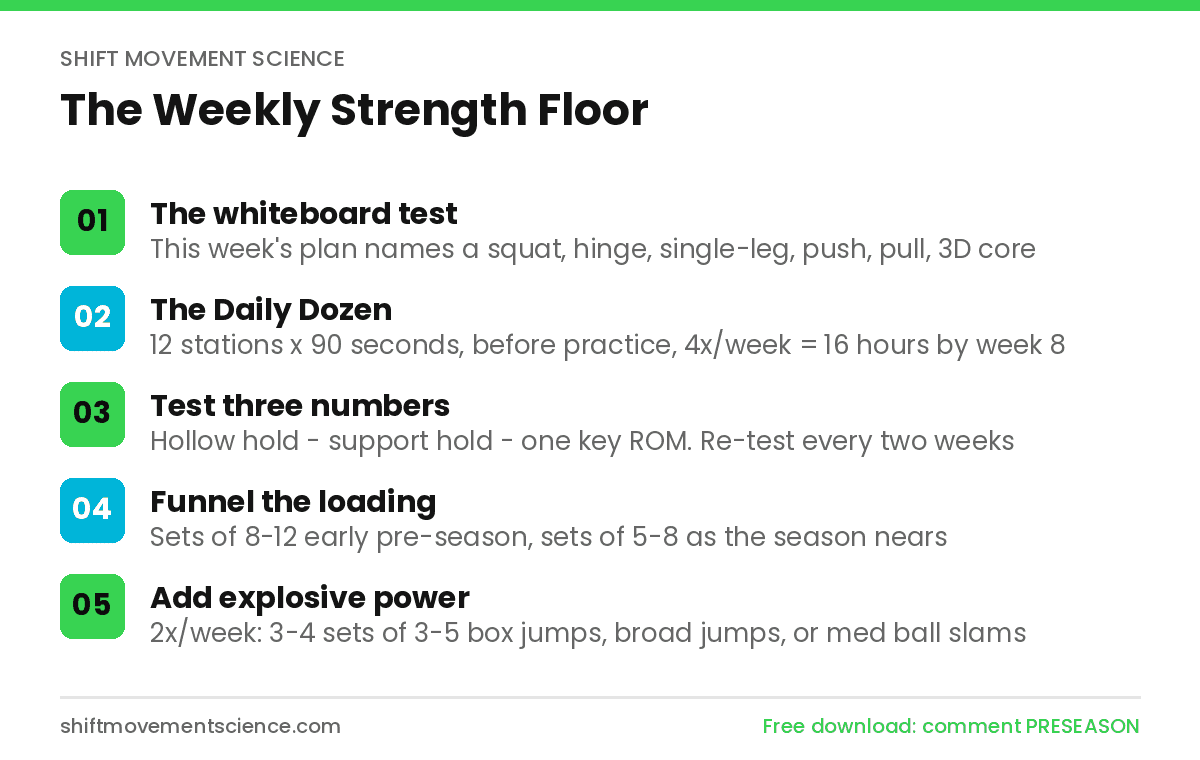
The fix — the Daily Dozen. Twelve stations, roughly 90 seconds each, run before the rest of practice, four times a week: brought to you by my good friend Nick Ruddock. If you want a free full 90 minute masterclass by us on this where he talks about the daily dozen, find it here.
Run it for 30 minutes, 4 times a week. Across eight weeks that’s 16 hours of cumulative, low-fatigue exposure — compared to something like 4–5 hours if the same twelve stations are only run “when we have time.” That gap is the entire argument. Track 2–3 simple numbers per athlete — hollow hold time, wrist or shoulder ROM, support-hold duration — and re-check every two weeks. The numbers are what turn “we should do basics” into “look what basics did.”
Myth 4: “Conditioning should just get harder every week, steadily.”
The myth: Progress means turning the dial up a little bit every single week, all season, in a straight line.
The truth: Conditioning isn’t one thing. It’s a dial you turn slowly, from “can they sustain effort” to “can they repeat maximal effort” — and those are two different physiological targets that require two different phases, not one continuous ramp.
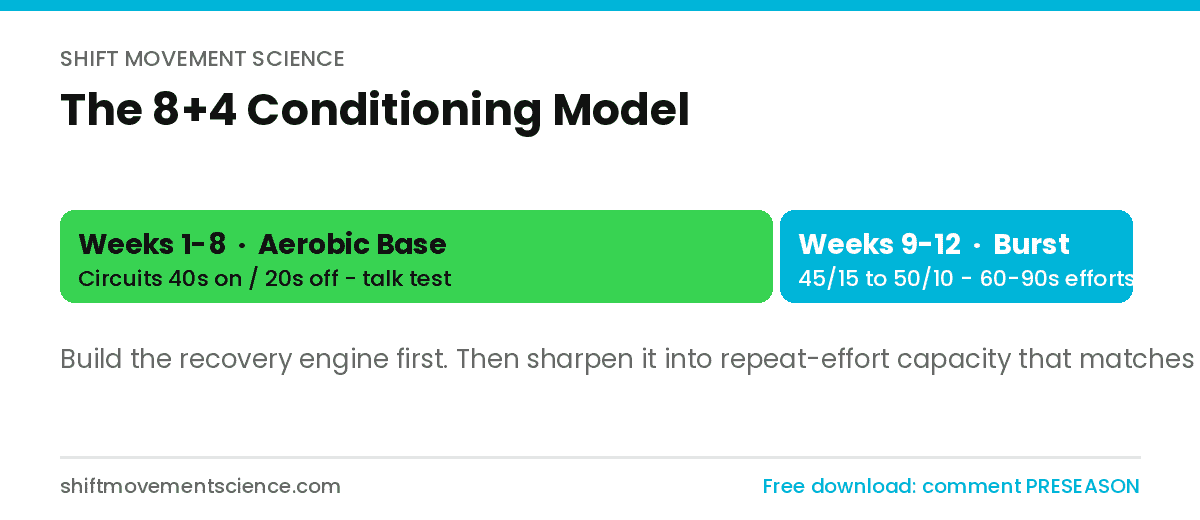
The fix — the 8+4 model. Run conditioning as circuits, not steady-state cardio, in two distinct phases:
Phase 1 — Aerobic Base (roughly 8 weeks). 2 rounds of 8–12 stations, 15–20 minutes, 2x/week. Start the work:rest interval at 40 seconds on / 20 off, and progress it as weeks pass — 40/20 → 45/15 → 50/10 — while also progressing the exercise demand itself (air squat → goblet squat → squat jump) and the reps per station. Use the talk-test as your intensity check: if an athlete can’t hold a conversation during the work interval, it’s too hard for where they are that week. This phase should already look like the sport — gymnastics shapes layered into the circuit, not eight weeks of pure jogging.
Phase 2 — Burst / Anaerobic Transition (roughly 4 weeks). Shift the work:rest ratio from close to even toward 1:2 up to 1:4, and shorten circuits toward 10–15 minutes, higher intent. This is where you match bout length to the Whiteboard Test number from Myth 1 — the 60–90 second maximal efforts that mirror an actual routine or a dense block of turns. Don’t drop the aerobic base entirely once this phase starts — keep one short maintenance session a week so the recovery engine underneath the burst work doesn’t atrophy right as the season demands the most from it.
You don’t build repeat-effort capacity by skipping straight to repeat efforts. You build it by building the recovery system underneath them first.
Myth 5: “Power just comes from doing more gymnastics.”
The myth: Explosiveness develops naturally through skill repetition — you don’t need to train it directly.
The truth: Rate of force development — the ability to produce force quickly — requires force to already exist. You cannot express force you never built. Skill repetition alone doesn’t reliably build the underlying maximal force output that explosive movement draws from.
The fix — dedicated explosive work. Layer 3–4 sets of 3–5 reps of true explosive movement into the week: box jumps, broad jumps, and medical ball slams, done with full recovery between sets so quality stays high and fatigue doesn’t creep into the count. This isn’t conditioning — treat it as its own quality, programmed with the same intent as a strength lift, not tacked onto the end of a tired practice.
Putting the blocks together
Here’s what a pre-season week can look like once these five blocks are running:
| Block | Frequency | Where it fits |
|---|---|---|
| Daily Dozen (basics) | 4x/week, ~30 min | Start of practice, before the rest of the session |
| Strength (movement patterns) | 2–3x/week, ramping 3–4×8–12 → 3–4×5–8 | Dedicated lift days, off the whiteboard event schedule |
| Explosive work | 2x/week, 3–4×3–5 | Fresh in the session, before fatigue sets in |
| Conditioning circuits | 2x/week, 15–20 min | 8-week aerobic base, then 4-week burst transition |
And across every one of these blocks, the load itself climbs at 5–10% per week — never more, even when a coach or an athlete feels ready to push harder. That number governs hours and intensity together. A gym can hold total hours flat while quietly doubling the difficulty of what happens inside those hours, and that’s still a spike the body has to absorb without warning.
The gym that walked in from the penthouse
There’s a line worth remembering as you build these blocks into your schedule: the programs that get the off-season and pre-season right walk into the competitive season from the penthouse.
The ones that wing it walk in from the basement. Neither gym looks different on the first day of pre-season. The difference shows up eight weeks later, in the gym running the Daily Dozen, the whiteboard test, and the 8+4 model — and the one still doing laps because that’s what’s always been done.
Build Your Engine This Week
1. Grab the free download. The 25-Box Pre-Season Checklist — including the full Strength & Power and Cardio & Energy Systems pillars, ready to run.
FREE Gymnastics
Pre Season Checklist
Gymnastics season is coming quickly! Get my "must-have" tips to set up your best competition year yet.
2. Take the free course. For the fundamentals behind every block in this post, the Essentials of Gymnastics Coaching course is free at shiftmovementscience.com/freecoaches/.
3. Go deeper in The Hero Lab. Full strength and conditioning templates, the complete Daily Dozen station list, and week-by-week 8+4 programming live inside The Hero Lab. Use code HEROINSIDER for 25% off your first month.
References
- Gabbett, T. — acute:chronic workload ratio and the training-injury prevention paradox (British Journal of Sports Medicine)
- Lloyd, R. & Oliver, J. (eds.) — Strength and Conditioning for Young Athletes: Science and Application
- Haff, G. & Triplett, N.T. (eds.) — NSCA’s Essentials of Strength Training and Conditioning (SAID principle, resistance training fundamentals)
- Bompa, T. & Buzzichelli, C. — Periodization: Training for Sports
- Boyle, M. — New Functional Training for Sports
- MacDougall, D. & Sale, D. — The Physiology of Training for High Performance
- Coyle, E.F. — aerobic power and recovery capacity between high-intensity efforts