

Here’s the thing most coaches miss about overhead flexibility: you can stretch the shoulder every single day and still watch a handstand line not improve.
That’s because full overhead motion is a kinetic chain, with many possible issues, and the first link isn’t the shoulder joint. When we understand the anatomy and stop yanking on the wrong tissue, we build range that actually shows up in skills and holds up over a career. Here are the five things I want every coach to understand.
Table of Contents
1. Overhead motion starts at the upper back, not the shoulder
Full arms-overhead requires the thoracic spine (upper back) to extend first. The sequence is literal: upper back opens → shoulder blades move → the shoulder joint moves → arms go overhead. A stiff upper back caps the whole chain no matter how much you stretch the arm.
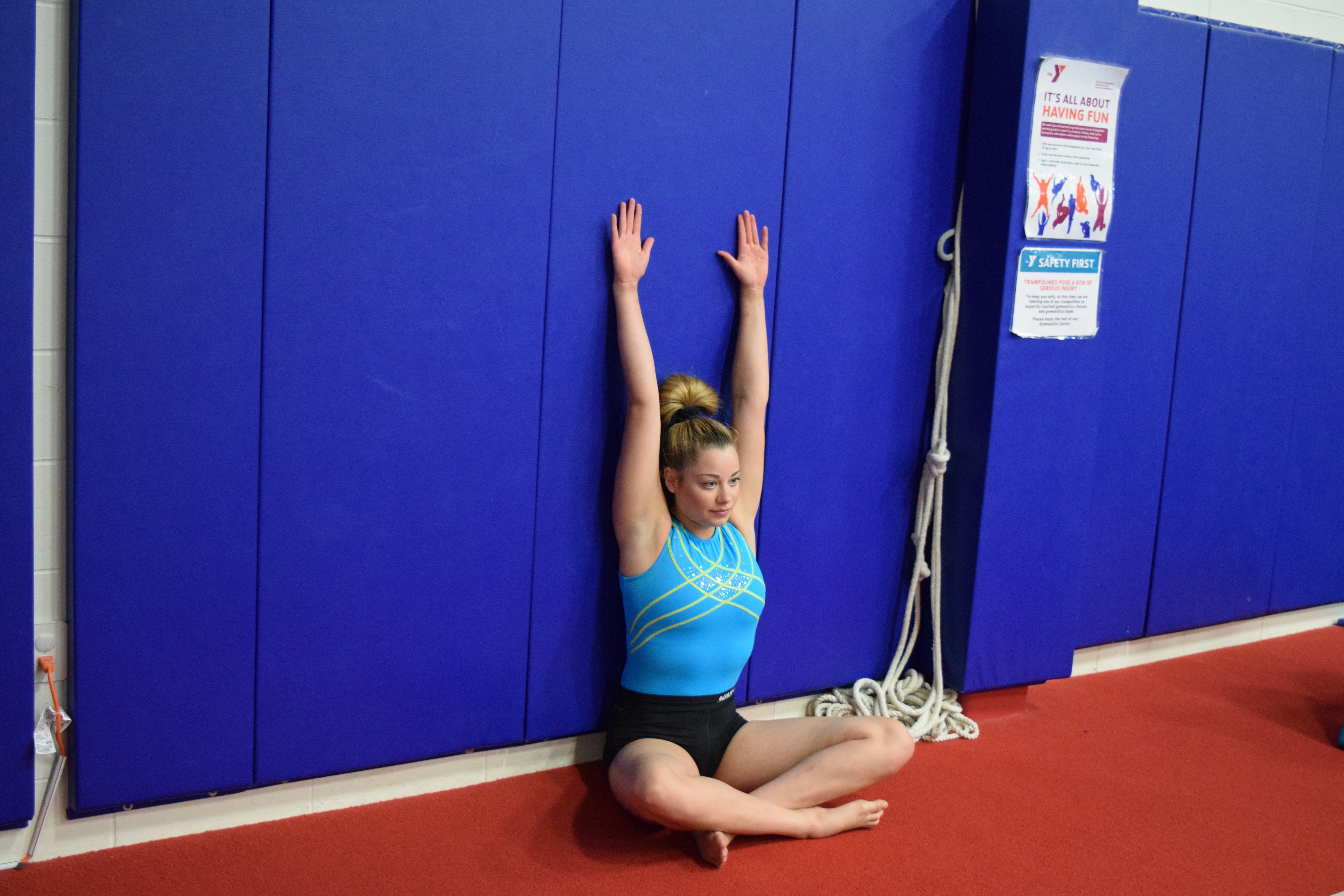
So screen there first. Use a press-up looking for an even upper-back curve (not a sharp hinge at one segment), and a seated rotation looking for 50-plus degrees each way. If those don’t pass, the upper back is your limiter. Open it with foam roller extensions and windmills for soft tissue, then hands-and-knees turns and “uppers” with a PVC stick for active range. Fix the base and the shoulder often “magically” improves.
2. Know the three layers — and stretch the right one
When motion is limited, one of three layers is responsible: bone alignment, the joint capsule and ligaments, or the muscle and tendon. You only get to safely change one of them. Muscles and tendons — lats, teres major, pec major and minor — are meant to be lengthened. Bone is fixed. And the capsule and ligaments are your passive stability; if you crank into stretches that pry those open, you don’t gain useful range, you gain laxity.
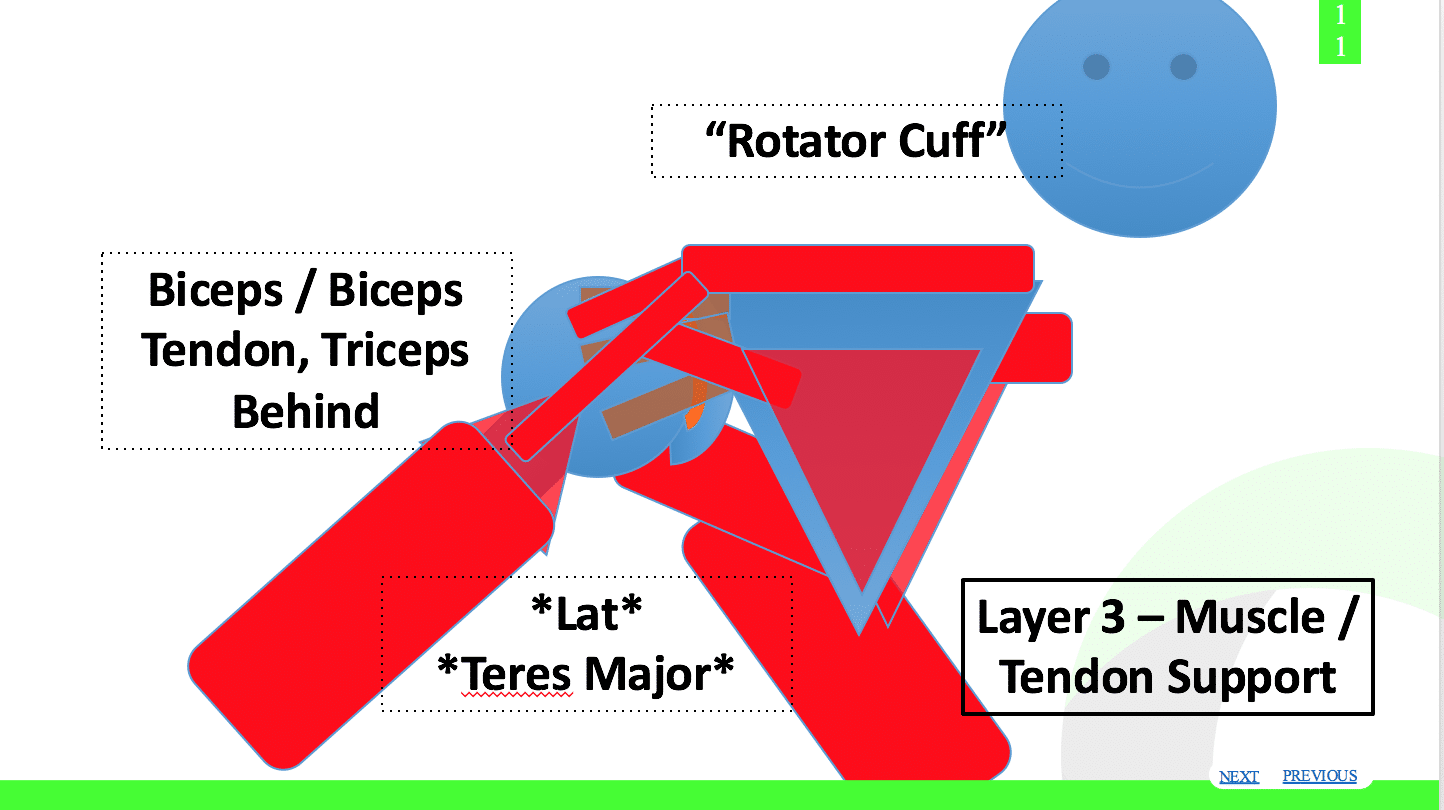
This is the caution the research literature has made for years around the overhead athlete’s shoulder (Reinold, Wilk, Wilk and Macrina): aggressive end-range stretching biased onto ligaments can irritate the joint and, over time, feed instability and injury. The tell in the gym is a gymnast who is loose everywhere but still can’t hold shapes under load. Bias your stretching onto muscle, protect the capsule, and build the rest with strength and skill work.
3. Don’t just stretch it — build it in layers
Flexibility that lasts is built in a sequence, not with one big pull. Move through soft tissue → eccentrics and active flexibility → skill basics, so new range is owned with strength and control. This is the SHIFT Performance Complex applied to the shoulder.
Here’s a concrete overhead complex — 2 to 3 rounds: 30 seconds of foam roll or lacrosse ball under the arm; 10 upper-back extensions over the roller; 30 seconds of PVC stick lat stretch plus a floor chest stretch; 5 eccentric chin-ups with a 5-second lower and 5-second hold; 10 stomach shoulder circles; then 30 seconds of a wall-facing tuck handstand. Notice the pattern — open the tissue, then immediately load and use the range. Range you can’t control isn’t flexibility, it’s just looseness.
4. Behind-the-back motion is its own skill — screen and train it separately
Overhead isn’t the whole picture. Behind-the-back shoulder motion drives front swings, hip extension on bars, arm swing in running, and dozens of positions coaches never connect back to the shoulder. It has its own screen: in a tabletop position, look for a 90-plus-degree shoulder angle with the hips staying open (a single-arm hands-and-knees shoulder circle checks each side).
Train it on its own track — foam roll lats, lacrosse ball on the pecs, chest openers over a roller, and hands-behind-back squeezes for tissue; then eccentric slider crawls, eccentric dips, hands-and-knees wall circles, and crab walks to load it. If you only ever train “arms overhead,” you leave half the shoulder undeveloped.
5. Balance every bit of flexibility with strength
The safest loose shoulder is a strong one. Pair your mobility work with pulling strength 2x per week, 3 to 4 sets of 8 to 12 — feet-elevated rows, face pulls, renegade rows, and bent-over dumbbell rows. This is what turns new passive range into shapes that hold when a double back hits the mat.
And keep the mindset right: extreme ranges are inevitable in this sport, so develop them on purpose. Bias the muscle in flexibility work first, then build very good strength, control, and basics, and use drills and technical progressions to grow range slowly. The solution looks nothing like the problem — the answer to a stubborn handstand shape is rarely one more hard stretch.
Want the full screens, the progressions, and the done-for-you shoulder circuits? This is exactly what I break down inside The Hero Lab — the upper-back and shoulder screening videos, the soft-tissue-to-active-flex complexes, and the strength-balance templates that build overhead range without wrecking joints. Use code HEROINSIDER for 25% off your first month, and give your athletes shoulders that are both mobile and bombproof. Click HERE to learn more.
— Dave
Dr. Dave Tilley, DPT, SCS, CSCS — SHIFT Movement Science
References & Further Reading
- Reinold, M.M., et al. (2013). Current concepts in the evaluation and treatment of the shoulder in overhead athletes.
- Wilk, K.E., et al. (2008). The disabled throwing shoulder: spectrum of pathology.
- Wilk, K.E. & Macrina, L.C. (2013). Nonoperative and postoperative rehabilitation of the overhead athlete’s shoulder.